
Corruption-Immunity Shield: When Accountability Is Recast as Persecution
Part 2 of “Naming the Democratic Breakdown,” a new series introducing original academic political science terms to help define modern political philosophy.

By Micah Blake Allred, MA Comparative Politics from American University SPA
January 20th, 2026
Democracies don’t fail because elected officials turn corrupt. If they did, no democracy would be left standing.
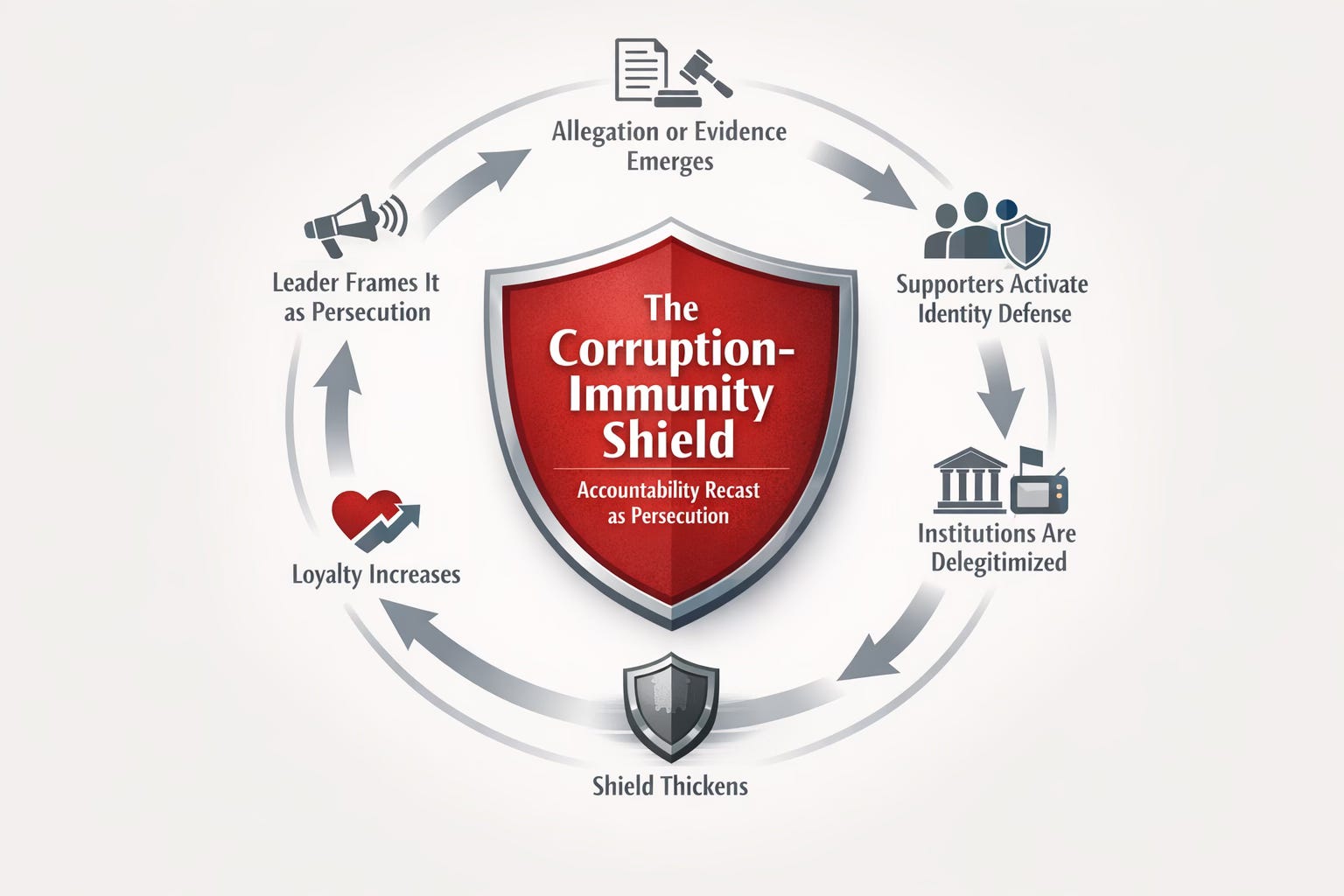
They fail when corruption stops carrying consequences. When a leader’s loyalists cease to recognize misconduct as wrongdoing at all. In a healthy democracy, credible evidence of abuse prompts outrage and accountability. Under what can be called a corruption-immunity shield, the same evidence deepens personalized political loyalties and confirms preconceived notions about the supposed corruption of the opposition and of core institutions.
Defining the Corruption-Immunity Shield
A corruption-immunity shield is a cognitive defense mechanism in which supporters of a political leader reinterpret credible evidence of that leader’s misconduct as illegitimate attacks from hostile institutions. Instead of functioning as an alarm, such evidence is reframed as proof of persecution by a “corrupt establishment.” Investigations, indictments, scandals, and even legal penalties are not seen as enforcement of democratic norms, but as institutional warfare by courts, prosecutors, and nonpartisan media organizations. In this logic, the problem is never what the leader has done; the problem is that these corrupt institutions (aka “they”) dared to investigate him at all.
Crucially, this is not about corruption being invisible. It is about corruption being reframed as virtue. The more proof surfaces, the more it feeds a persecution narrative. In the eyes of fervent supporters, each allegation confirms that their champion is an embattled outsider fighting a wicked system on their behalf. Evidence that would normally trigger doubt instead becomes fuel for loyalty.
Trump’s Indictments, Conviction, and the Shield
The United States in the post-2020 era offers a vivid case. Donald Trump lost re-election in 2020 and then faced an unprecedented wave of legal scrutiny: two impeachments, and four criminal cases that initially totaled 91 felony counts across New York, federal courts, and Georgia, covering allegations from falsifying business records to obstructing justice and conspiring to overturn the 2020 election.
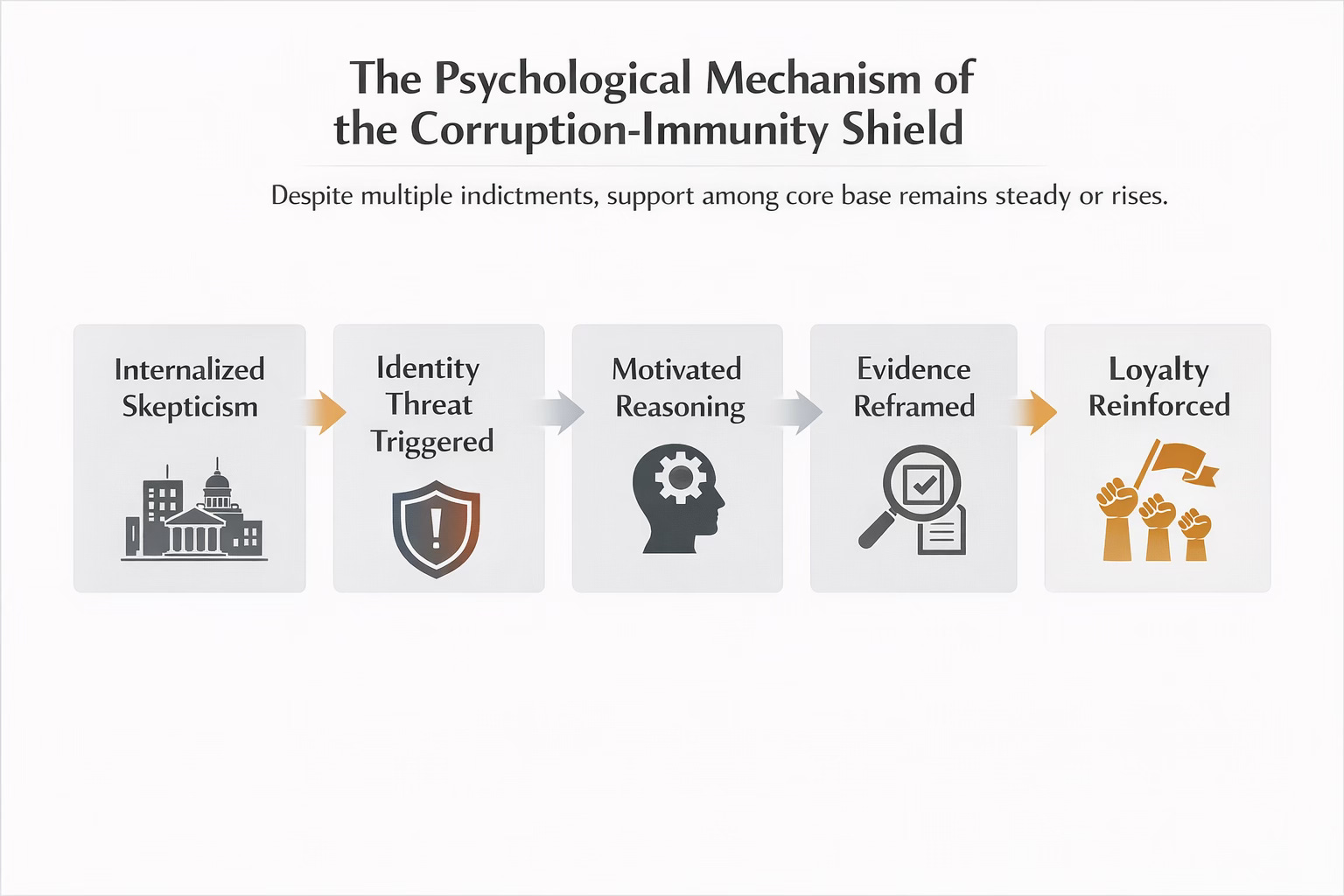
By any traditional standard, these well-documented accusations—and eventually, a criminal conviction—should have shattered his standing. On May 30, 2024, a Manhattan jury found Trump guilty on all 34 felony counts of falsifying business records in the New York hush-money case. A snap YouGov poll the same day found that 50% of Americans agreed with the verdict, while 30% disagreed. Yet nearly 80% of Americans said the conviction did not change their vote intentions: 46% were already opposed to Trump and remained so, and 32% already supported him and continued to do so. Only 5% reported switching from supporting Trump to opposing him because of the verdict, while 3% moved in the opposite direction.
Among Republicans, the shield was even more durable. A June 2023 Reuters/Ipsos poll conducted after Trump’s federal indictment found that 81% of self-identified Republicans believed the charges were politically motivated. A separate YouGov poll showed that 79% of Republicans believed Trump should not be convicted in the hush-money case, even before the verdict. After the conviction, most Republican voters said the verdict would not change their support for him.
Perhaps most revealing is what happened to institutional trust. Before the hush-money verdict, Republicans and Democrats expressed somewhat similar levels of confidence in jury trials. Immediately afterward, partisan attitudes flipped sharply. After the verdict, 78% of Republicans said the prosecution, trial, judge, or jury had been unfair. The institution responsible for finding facts did not merely lose legitimacy among Trump’s base—it was reclassified as part of the “corrupt system” persecuting their champion. In short, even a criminal conviction—arguably the strongest possible formal signal of wrongdoing—was absorbed into the persecution narrative rather than accepted as proof.
This is the corruption-immunity shield in its mature form: legal peril and even a guilty verdict become rallying cries, not cautionary tales. Trump himself leaned into this dynamic, telling supporters at rallies, “They’re not indicting me, they’re indicting you. I just happen to be standing in their way,”—turning personal accountability into a shared grievance.
When Scandals Used to End Careers
This response marks a sharp break from an earlier era in American politics. In the 1970’s and 1980’s, serious scandal often ended—not boosted—political careers. Richard Nixon resigned on August 9, 1974, after the Watergate tapes and the “smoking gun” evidence convinced even Republican leaders that he had obstructed justice; facing almost certain impeachment and removal, his party abandoned him. Spiro Agnew resigned as vice president in 1973 after pleading no contest to tax evasion charges stemming from a bribery and kickback scheme during his tenure as governor of Maryland.
The contrast with Trump is stark. Where earlier scandals punctured credibility, Trump’s legal troubles have become central to his political brand. Allegations of wrongdoing do not weaken his bond with loyalists; they prove, in their eyes, that he is the victim of a corrupt establishment determined to crush their movement.
A Global Pattern: Bolsonaro, Netanyahu, Berlusconi
Trump’s case may be the most familiar to Americans, but similar shields have formed around other populist or authoritarian-leaning leaders.
In Brazil, former President Jair Bolsonaro was accused of systematically undermining the 2022 election results and encouraging efforts to overturn the outcome, culminating in the January 8, 2023 storming of government buildings in Brasília. Brazil’s electoral court banned him from running for office until 2030 for election abuses, and on September 11, 2025, the Supreme Court convicted him on multiple charges, including plotting a coup and participating in a criminal organization, sentencing him to 27 years and three months in prison. Bolsonaro has consistently called the investigations and the trial a “witch hunt” and a politically motivated effort to silence him. Many of his supporters have echoed that narrative, framing the judiciary and the Supreme Court—not Bolsonaro—as the true threat to democracy, and staging protests against the justices rather than the alleged coup plotters.
In Israel, Prime Minister Benjamin Netanyahu has spent years fighting three major corruption cases, charging him with bribery, fraud, and breach of trust, including allegations of receiving roughly $300,000 in luxury gifts and trading regulatory favors for favorable media coverage. Netanyahu has cast the entire process as an “illicit attempt” by a left‑leaning alliance of politicians, prosecutors, police, and media to remove him from power for ideological reasons, and his allies frequently describe the proceedings as a judicial “coup d’état” by unelected elites. A large segment of Israeli society now views the courts with suspicion, treating Netanyahu’s legal troubles as evidence of his importance: if the establishment is so determined to take him down, he must be doing something right.
Italy’s Silvio Berlusconi arguably pioneered this style of immunity shield in the 1990s and 2000s. Over his career he faced some 35 criminal cases—including allegations of tax fraud, bribery, and witness tampering—and was convicted only once in a final verdict, for tax fraud in 2013. Throughout, Berlusconi claimed he was the victim of politically motivated persecution by “communist judges” and rogue magistrates. By persuading his supporters that the judiciary was merely a weapon in the hands of his enemies, he repeatedly bounced back from scandals that would likely have ended other leaders’ careers, returning to office and maintaining a major party as a pillar of Italy’s right.
Across these cases, the pattern is consistent. Faced with credible accusations of wrongdoing, the leader and his camp rarely engage with the evidence: they attack the arbiters. Allegations of corruption are not rebutted point-by-point; they are absorbed into a pre-existing story about persecuted patriots besieged by villainous institutions.
How the Shield Forms: Internalized Political Skepticism
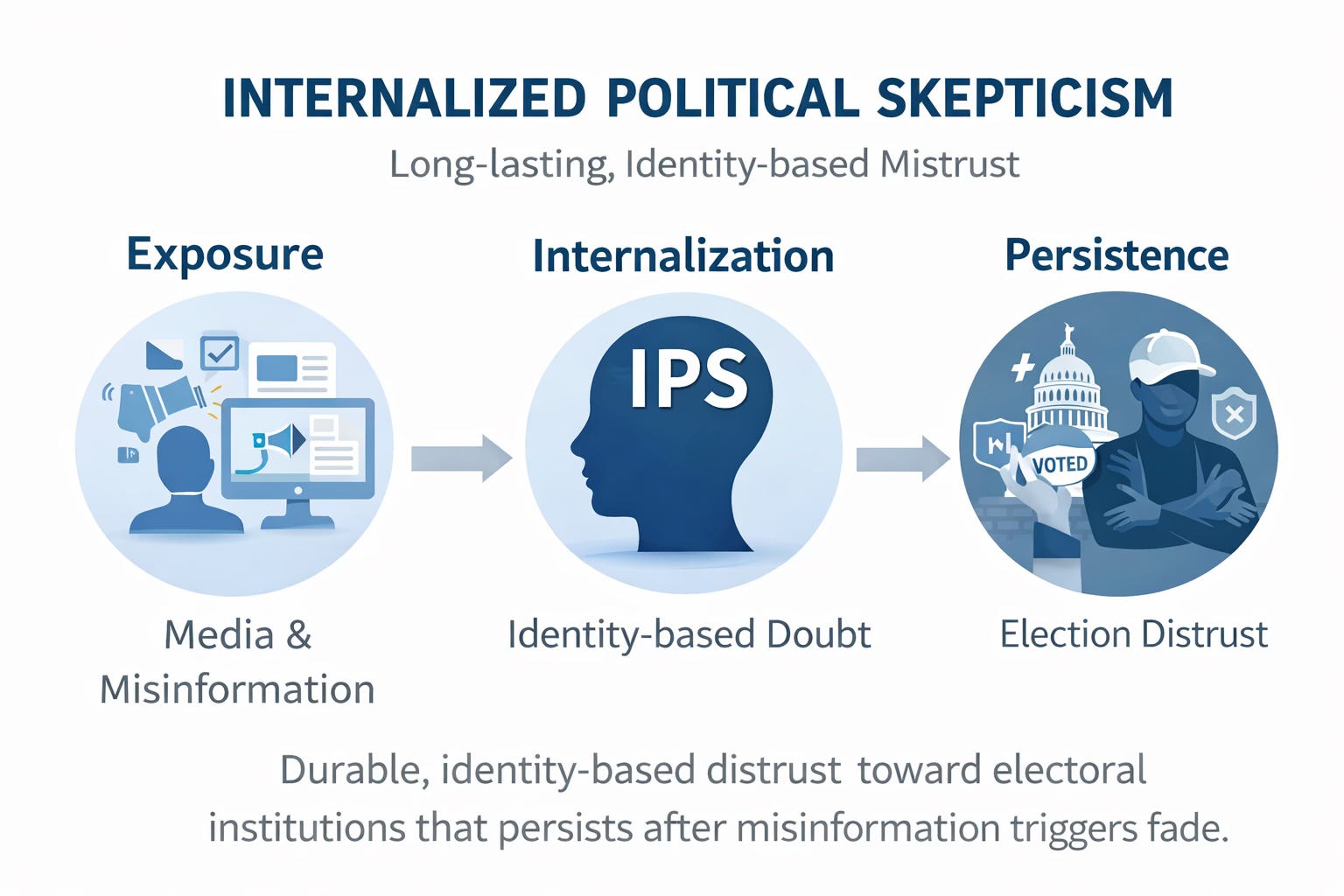
A corruption-immunity shield does not emerge overnight, nor is it simply a product of blind fanaticism. It takes root most readily in societies where distrust of institutions has already been deeply internalized as part of political identity. What can be called internalized political skepticism is a durable, identity-based distrust towards electoral institutions that persists after misinformation triggers have faded.
This prior institutional skepticism provides the fertile soil in which a corruption-immunity shield can grow. If citizens already assume that “the press lies,” prosecutors are partisan, and a “deep state” is real, then any accusation against their chosen leader slots neatly into that worldview. Without such prior skepticism, supporters might still feel partisan loyalty, but blatant misconduct would be harder to dismiss outright. Once skepticism toward official information is ingrained, however, each new allegation of corruption simply reinforces the conviction that “the system” is out to get “our side.”
Several ingredients typically interact to harden the corruption-immunity shield:
Repeated elite cues: Political leaders and aligned media figures broadly insist that “the media lies,” judges are “corrupt,” and elections are “rigged.” Over time, these claims erode the credibility of watchdog institutions and help transform distrust into an identity marker of being on the “inside” of the social movement.
Fragmented information environments: Partisan media ecosystems, algorithm-driven echo chambers, and closed messaging apps amplify persecution narratives and filter out corrective information, reinforcing identity-protective cognition in which people selectively accept or reject facts based on group alignment rather than accuracy.
Perceived grievance and marginalization: Groups that feel culturally threatened or politically sidelined are more likely to embrace stories of a scheming establishment. A leader who says “the establishment hates me because it hates you” offers both an explanation for their frustrations and a flattering moral identity as embattled truth-tellers.
All these forces accumulate over years. At first, a scandal might cause some discomfort or doubt. But if the leader brazenly dismisses each allegation as a “hoax” and faces no real disavowal from the base, supporters learn to do the same. Each successful deflection hardens the shield. Eventually it becomes self-sealing: new evidence of misconduct simply confirms the belief that powerful institutions are unfairly sabotaging the leader and, by extension, those who support him. Renouncing the leader would then feel, for many, like betraying their own identity. At that point, empirical accountability is effectively nullified.
Accountability Breakdown in Democracies
The democratic dangers of this phenomenon are difficult to overstate. Modern democracy rests on the principle that leaders can be checked and peacefully removed when they violate public trust. Elections, independent courts, legislative oversight, and investigative journalism form a web of accountability that deters would-be autocrats and crooks. The corruption-immunity shield tears holes in that web.
If a large enough bloc of citizens refuses to believe inconvenient truths, a politician can evade consequences simply by denying everything and vilifying the arbiters of fact. In the U.S., Trump’s continued popularity among Republican voters—even after felony conviction—helped intimidate many GOP elites into silence or active defense of him, despite the gravity of his legal troubles. Fearful of alienating the Republican base, even rival 2024 presidential candidates echoed “weaponization of federal law enforcement” narratives instead of insisting on accountability. Over time, this dynamic can enable leaders to entrench loyalists in key positions, further weakening independent oversight.
This is not mere partisan forgiveness or “lesser-evil” reasoning, which exists in all democracies. A corruption-immunity shield represents an inversion of accountability: wrongdoing is not just excused, but celebrated if it offends the perceived establishment. Breaking norms becomes proof of courage, and evading the law is recast as clever defiance of a corrupt system. When a leader can openly joke at rallies that criminal indictments are politically beneficial, drawing laughter, applause, and increased approval ratings, the ordinary relationship between evidence, accountability, and belief has been flipped on its head.
Backsliding Without a Coup
Democratic backsliding research has shown that many modern democracies erode gradually, not through dramatic coups but via incremental norm-breaking, partisan capture of institutions, and declining trust. Scholars tracking this phenomenon have documented how elected leaders in countries such as Hungary and Turkey have used formally legal tools, institutional manipulation, and propaganda to hollow out checks and balances while maintaining elections and constitutional facades
A robust corruption-immunity shield accelerates this process. In Russia and Turkey, state-aligned media have long portrayed opposition figures, journalists, and civil society organizations as traitors or foreign agents; corruption charges against incumbents are dismissed by supporters as smears by hostile outsiders. In newer democracies such as Hungary, leaders accused of undermining judicial independence or media freedom routinely frame EU criticism as bullying by globalist elites, rallying their bases against “Brussels” rather than addressing the allegations.
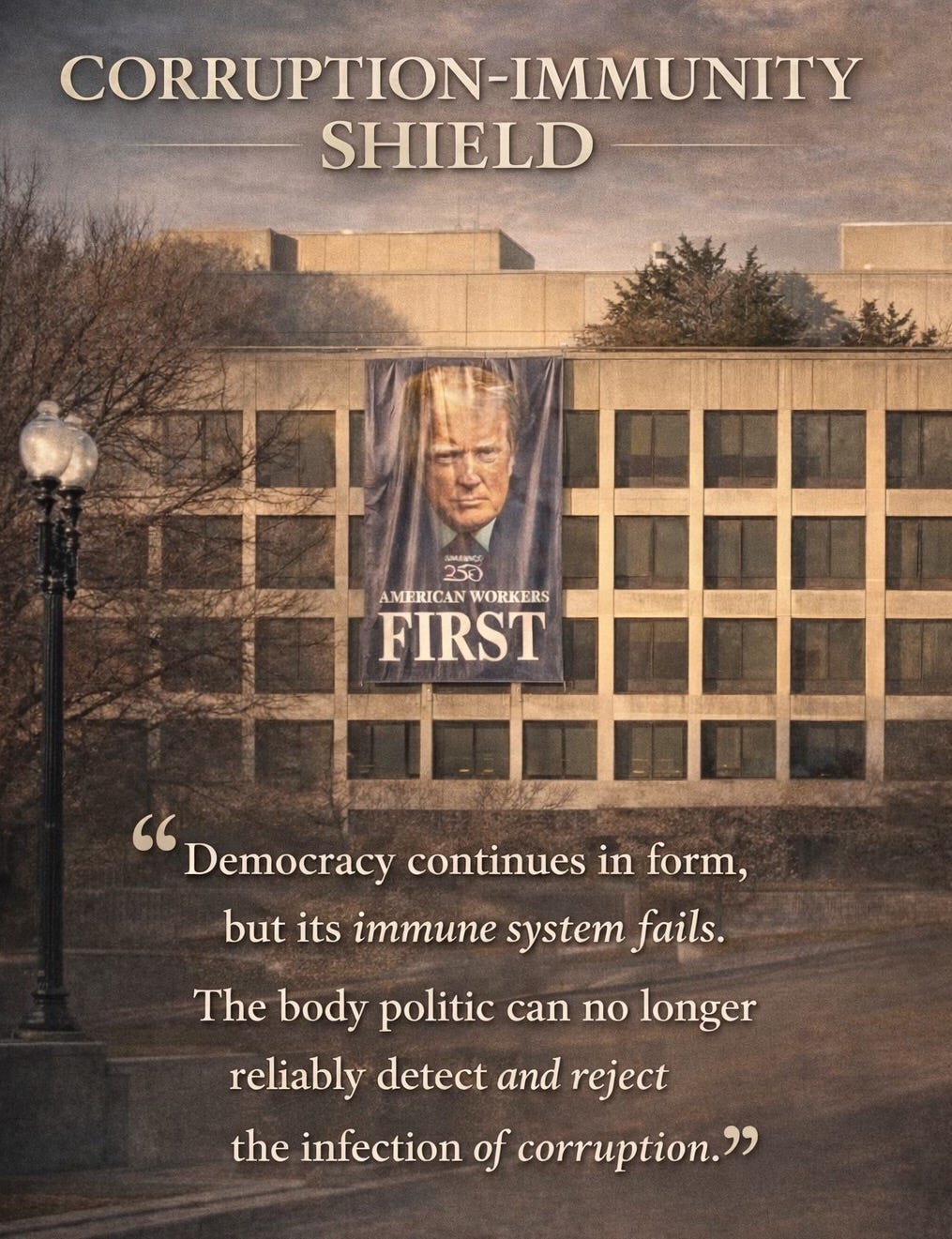
The logic is consistent: if my leader is accused, that accusation itself proves the accuser’s evil. As trust in institutions decays, formal procedures—elections, court rulings, investigative reports—lose their corrective power. Democracy continues in form, but its immune system fails. The body politic can no longer reliably detect and reject the infection of corruption.
Connecting the Dots: A Broader Framework
The corruption-immunity shield is closely intertwined with other mechanisms of democratic breakdown. Prior institutional skepticism lays the psychological groundwork by normalizing deep distrust of institutions. Asymmetric losers’ consent—when one side repeatedly refuses to accept electoral defeat as legitimate—further corrodes democratic norms. And what might be called an opposition-dominance assumption—the belief that nearly all institutions have been captured by the opposing camp—feeds the impulse to treat any action by those institutions as inherently illegitimate.
Together, these dynamics create a larger pattern:
Citizens come to believe that their side can never legitimately lose, only be cheated.
Any investigation or prosecution of their leaders becomes, by definition, a partisan attack.
Evidence of corruption no longer prompts course correction, but deeper entrenchment.
In such an environment, democracies can “forget” how to correct themselves long before they formally collapse. A country may still hold elections and convene courts, but if large segments of the public and political elite refuse to accept unfavorable outcomes, the system’s self-healing capacity is gravely weakened.
Why Naming the Shield Matters
Giving these dynamics names is not an academic indulgence; it is a necessary step toward countering them. The term “corruption-immunity shield” may be new, but its effects are visible in headlines almost daily. Naming it helps clarify what separates ordinary partisanship from something more dangerous: a state in which facts about corruption are systematically repelled rather than considered.
Recognizing that “simply revealing the truth” is not enough is uncomfortable, but essential. Investigative journalism, court cases, and watchdog reports remain vital, yet information alone cannot puncture an identity-based shield and may even reinforce it. This suggests that pro-democracy actors need strategies that address underlying grievances and group identities, not just the factual record.
Such strategies might include:
Supporting trusted voices within skeptical communities who can challenge persecution narratives from the inside.
Rebuilding civics education and media literacy so that fewer citizens slide into total cynicism about all institutions.
Re-establishing cross-partisan norms: political leaders must be willing to denounce corruption on their own side, not only across the aisle.
The corruption-immunity shield is potent, but not inevitable. It is a learned way of seeing the world, and what is learned can, in principle, be unlearned. The warning, however, is clear: democracies can lose their ability to heal themselves long before they formally die. When internalized political skepticism erodes trust, and the corruption-immunity shield reframes accountability as persecution, democracies edge toward a critical failure of their immune system. Recognizing this pattern is the first step toward rebuilding the antibodies of accountability before it is too late.
Micah Allred is a politics researcher, political journalist, and former AmeriCorps Disaster Corps Project Lead with an MA in Comparative Politics from American University. My work focuses on democratic trust, disinformation, and institutional breakdown in the U.S. and comparative democracies. My Substack Micah Allred publishes original political analysis, creative writing, and entrepreneurial ideas. I’m actively seeking paid work in political journalism, research and analysis, policy communications, startup/entrepreneurship, and adjacent writing or consulting roles.
Your subscriptions and donations make my independent journalism possible and help keep costs down for new subscribers. If you appreciate my work and see its value in our political discourse, please become a paid subscriber and spread the word!
Works Cited
Bermeo, Nancy. “On Democratic Backsliding.” Journal of Democracy 27, no. 1 (2016): 5–19. https://www.journalofdemocracy.org/articles/on-democratic-backsliding/.
CBS News. “Full Transcript of ‘Face the Nation,’ July 30, 2023.” CBS News, 29 July 2023, https://www.cbsnews.com/news/full-transcript-of-face-the-nation-july-30-2023/.
DW. 2020. “Netanyahu Alleges ‘Coup Attempt’ as Corruption Trial Opens.” Deutsche Welle. https://www.dw.com/en/netanyahu-alleges-coup-attempt-as-corruption-trial-opens/a-53552294.
Kahan, Dan M. “Misinformation and Identity-Protective Cognition.” Yale Law & Economics Research Paper, no. 587, 2017, https://ssrn.com/abstract=3046603.
Layne, Nathan. “Trump’s Republican Rivals Criticize ‘Weaponization’ of Justice Department After Indictment.” Reuters, June 9, 2023.
https://www.reuters.com/world/us/trumps-republican-rivals-criticize-weaponization-doj-after-indictment-2023-06-09/.
Levitsky, Steven. “A Grim Assessment of American Democracy Under Trump.” NPR: Fresh Air, April 22, 2025, https://www.npr.org/2025/04/22/nx-s1-5372334/.
Levitsky, Steven, and Lucan A. Way. “The Path to American Authoritarianism.” Foreign Affairs, March–April 2025. https://marcellus.in/story/long-read-the-path-to-american-authoritarianism-what-comes-after-democratic-breakdown/.
Levitsky, Steven, and Daniel Ziblatt. How Democracies Die. Crown Publishers, 2018. https://levitsky.scholars.harvard.edu/publications/how-democracies-die.
Lis, Jonathan. “Victim of a Left-Wing Coup? Why Netanyahu’s Conspiracy Theory Is Foul and Absurd.” The Times of Israel, 24 May 2020, https://www.timesofisrael.com/victim-of-a-left-wing-coup-why-netanyahus-conspiracy-theory-is-foul-and-absurd/.
Malig, Kaela, and Kristina Abovyan. “A Guide to the Criminal Cases Against Donald Trump.” PBS Frontline, 30 Jan. 2024, https://www.pbs.org/wgbh/frontline/article/a-guide-to-the-criminal-cases-against-donald-trump/.
Naylor, Brian. “222 Democrats, 10 Republicans Vote to Impeach Trump for a 2nd Time.” NPR, 13 Jan. 2021, https://www.npr.org/2021/01/14/956705074/222-democrats-10-republicans-vote-to-impeach-trump-for-a-2nd-time.
Noe, Kristian Skrede. “Dynamic Democratic Backsliding.” British Journal of Political Science, vol. 55, no. 1, 2025, pp. 1–26, https://www.cambridge.org/core/journals/british-journal-of-political-science/article/dynamic-democratic-backsliding/C1D2980155E0.
NPR Staff. “Brazil’s Ex-President Bolsonaro Sentenced to 27 Years for Coup Plot.” NPR, September 11, 2025, https://www.npr.org/2025/09/11/nx-s1-5535658/bolsonaro-brazil-coup-trial.
Reuters. “Russia Adopts New ‘Foreign Agents’ Law to Target Domestic Opponents.” Reuters, 29 June 2022, https://www.reuters.com/article/business/russia-adopts-new-foreign-agents-law-to-target-domestic-opponents-idUSL8N2YG2VK/.
RFE/RL. 2021. “EU Warns Hungary, Poland Over Rule Of Law, Media Freedom.” Radio Free Europe/Radio Liberty. https://www.rferl.org/a/hungary-media-freedom-rule-of-law/31368720.html.
Smeets, Samantha, et al. “The Role of Emotions and Identity-Protection Cognition When Drawing Inferences from Politicized (Mis-)Information.” APA Open, vol. 7, no. 2, 2021, pp. 1–14, https://tmb.apaopen.org/pub/osng25l7.
The New York Times. “Trump Guilty on All Counts in Hush-Money Case.” The New York Times, May 30, 2024, https://www.nytimes.com/live/2024/05/30/nyregion/trump-trial-verdict.
The New York Times. “The Netanyahu Corruption Trial, Explained.” The New York Times, December 10, 2024, https://www.nytimes.com/article/netanyahu-corruption-trial-pardon.html.
U.S. Department of State, Bureau of Democracy, Human Rights and Labor. 2018 Country Reports on Human Rights Practices: Turkey. U.S. Department of State, 2019, https://www.state.gov/reports/2018-country-reports-on-human-rights-practices/turkey/.
Weil, Martin. 2003 “Spiro T. Agnew Resigns Vice Presidency in Disgrace.” The Washington Post. Washington, D.C. https://www.washingtonpost.com/archive/politics/1996/09/18/former-vice-president-spiro-t-agnew-dies-at-77/9792a13a-6890-4c41-965b-1cd517dedae0/.
Wells, Ione. “Bolsonaro’s Coup Trial Gripped Brazil—and His Conviction Will Divide It.” BBC News, September 11, 2025, https://www.bbc.com/news/articles/cj3yekj2xygo.
“Why Trump’s Poll Lead Went Up After Criminal Indictments.” BBC News, August 1, 2023, https://www.bbc.com/news/world-us-canada-66274979.
YouGov. “Snap Poll: 50% of Americans Approve of Trump’s Hush-Money Conviction.” YouGov, May 30, 2024, https://today.yougov.com/politics/articles/49569-snap-poll-50-of-americans-approve-of-trumps-hush-money-conviction.
Zurcher, Anthony. “Why Trump’s Poll Lead Went Up After Criminal Indictments.” BBC News, 1 August 2023. https://www.bbc.com/news/world-us-canada-66274979.