
Freedom Summer 2.0
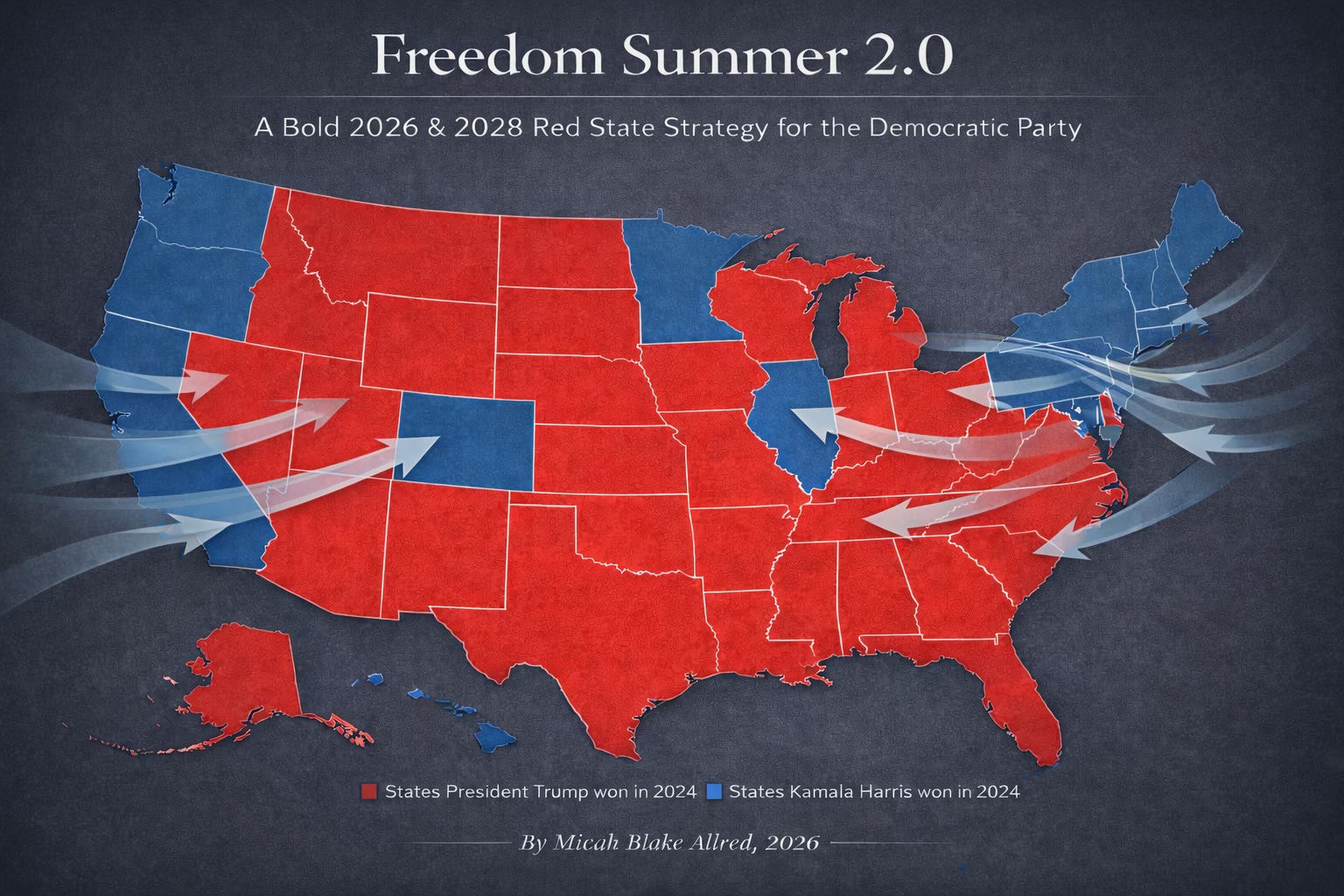
To have any chance at an unshakeable House majority and 60-seat Senate majority, the Democratic Party must develop a bold Red State strategy for 2026 & 2028.

By Micah Blake Allred.
A version of this article first appeared in Our National Conversation on January 20th, 2026.
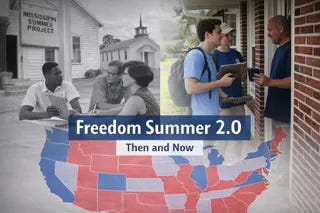
The summers before the 2026 midterms and the 2028 presidential election will be one of the most consequential political moments Gen Z and millennials ever face. We need two modern Freedom Summers where volunteers from safe blue states volunteer to travel to deep red states to register voters, provide community aid, and explain democratic rights, face to face.
Social media activism is saturated. Institutions are strained. If democracy is going to hold, it will be because people showed up where it is weakest, not where it is easiest.
Freedom Summer in 1964 sent just over a thousand mostly white college students into Mississippi to work alongside Black organizers who had already been risking their lives for years. Together they helped about 17,000 Black Mississippians attempt to register to vote, even though registrars under Jim Crow actually added only around 1,600 of them to the rolls. The campaign also launched more than 40 Freedom Schools that educated thousands of kids and adults in Black churches and community centers across the state. The raw numbers were modest. The impact on national consciousness and on the Voting Rights Act was not.
The Democratic Party must recreate this bold strategy with a Freedom Summer 2.0.
To have any chance at an unshakeable House majority and 60-seat Senate majority, the Democratic Party must develop a bold Red State strategy for 2026 & 2028. Freedom Summer 2.0 has to think at a different scale and under very different conditions. Instead of the Jim Crow South, the battlefield is an entire map of gerrymandered districts, razor‑thin presidential margins, and millions of disillusioned nonvoters from Florida to Alaska.
The question I keep coming back to is simple:
If tens of thousands of people from safer, bluer places spent their summers knocking doors and building relationships in the country’s most under‑organized corners, how many votes could they realistically move—and where would that effort flip outcomes?
What follows is a rough, conservative answer.
It’s built on three assumptions:
We anchor everything in what field experiments and past campaigns have actually achieved.
We accept that volunteers are human: they get tired, they get lost, they have awkward conversations, and half their shifts go sideways.
We focus on federal power—presidency, Senate, and House. Freedom Summer 2.0 is not about telling Arizona or Alabama how to run the towns that out-of-state volunteers just arrived in. It’s about whether we collectively get a functioning democracy, a sane national government, and a national infrastructure, tax code, and social safety net that favor the neediest over the richest Americans.
The states I’m looking at are a deliberately broad mix of purple, red, and deep red states. Some are swing states that require obvious attention, some are red states with serious potential for expanding the Democratic Party base, and others are deep red states where electoral suppression and uncontested races can no longer go unchallenged:
Arizona, Nevada, Texas, Louisiana, Alabama, Mississippi, Florida, Maine, Alaska, Kentucky, North Carolina, Ohio, South Carolina, West Virginia, Pennsylvania, Georgia, Michigan, Iowa, Nebraska, Utah, Montana, Tennessee, Kansas, and Oklahoma.
What One Summer Volunteer Can Actually Do
Campaigns love to tell volunteers that “every door you knock is a vote.” The political science literature is less romantic but more useful.
For two decades, researchers like Donald Green and Alan Gerber have run randomized field experiments on voter turnout. Their core finding is that high‑quality, face‑to‑face canvassing—especially with low‑propensity voters who already lean your way—can raise turnout among the people you actually reach by a few percentage points. A landmark set of experiments in New Haven found in‑person canvassing increased turnout by roughly 7 percentage points among registered voters contacted, while phone calls and direct mail had much smaller effects. More recent meta‑analyses suggest that in real‑world conditions, especially in high‑salience elections, the boost is more often in the 2–4 point range.
Now layer on what we know from how modern campaigns actually run. In a presidential year, a motivated, trained volunteer who treats this as their full‑time summer job might be able to:
Knock doors or make calls several days a week.
Have a few dozen meaningful conversations per shift (not just lit drops).
Log, very roughly, 800 to 1,200 real contacts over a season when you factor in missed houses, no‑answers, and burnout.
If you combine those pieces and stay conservative, the math for a full‑summer Freedom Summer 2.0 volunteer looks like this:
They have about 1,000 meaningful conversations in the course of a summer—some in person, some by phone, some by text.
They focus those conversations on low‑propensity voters who already lean Democratic or are persuadable.
Their work, combined with follow‑up texts and mail closer to Election Day, produces a 2–3 percentage‑point increase in turnout among the people they contact.
A 2–3 point increase among 1,000 targeted voters is 20–30 additional ballots cast that otherwise wouldn’t have shown up. Add in a smaller number of actual new registrations (which matter most in places like Texas, Florida, Alabama, and Mississippi, where registration rates lag the national average) and some persuasion on genuinely conflicted independents, and a fair working range is:
Each full‑summer Freedom Summer 2.0 volunteer can realistically “net” somewhere between about 20 and 40 votes.
That range assumes competent training, smart targeting, and a program that doesn’t just throw volunteers out with clipboards and hope for the best. It also assumes we aren’t counting every friendly conversation as a converted voter. This is the conservative baseline I use for everything that follows.
Once you accept that each properly deployed volunteer is worth something like 20–40 net votes over the course of a summer and the rest of the cycle, the basic formula per state is straightforward:
Number of volunteers needed ≈ Votes needed to flip ÷ Net votes per volunteer
For the presidency, the best proxy for “votes needed to flip” is the 2024 presidential margin in that state. For Senate races, the presidential margin tends to overstate the difficulty a bit, and for House races it can overstate it a lot, but as a starting point it’s better than wishful thinking.
The real question is: how many net votes do they represent, and how many summer volunteers would it take to erase those margins if everything else stayed equal?
The Closest States: Nevada, Pennsylvania, Michigan, Georgia, North Carolina, Arizona, Maine
Start with Nevada. In 2024, Trump beat Harris there 50.6% to 47.5%, a bit more than a three‑point margin in a state where roughly 1.5 million people cast presidential ballots. Three points in that ballpark is on the order of 45,000 votes.
If each full‑summer volunteer nets 20–40 votes, then, in the most mechanical sense, closing that margin purely via turnout and registration would take:
Around 2,250 volunteers at 20 votes each.
Around 1,125 volunteers at 40 votes each.
Realistically, you never get pure isolates like that—some of the people you mobilize are already in the habit of voting, some counties are better organized than others—but as an order of magnitude, one to two thousand serious summer volunteers in Nevada is not a fantasy number. It’s what it would take to meaningfully compete with the right’s advantage there.
Pennsylvania is bigger and closer. Trump’s 50.4% to 48.7% result translates to a margin of about 1.7 percentage points in a state where more than 7 million people cast ballots. 1.7 percent of 7 million is roughly 120,000 votes. Run the same division:
At 20 net votes per volunteer, you’d need around 6,000 full‑summer volunteers to erase that gap.
At 40 net votes per volunteer, you’d need around 3,000.
Those volunteers would not all be in Philadelphia and Pittsburgh. They’d be spread through the Lehigh Valley, the small cities, the exurbs, the places where marginal, disillusioned Democrats and left‑leaning independents have been drifting out of the electorate while older, whiter conservatives keep voting every cycle.
Michigan and Georgia have similar dynamics. In Michigan, Trump’s 49.7% to 48.3% is a 1.4‑point edge. In Georgia, 50.7% to 48.5% is a 2.2‑point edge. In raw‑vote terms, those are tens of thousands of ballots, not hundreds of thousands. Again, running the math at 20–40 votes per volunteer gets you into the range of low thousands of intensive volunteers per state to make up the difference—on top of everything campaigns and local groups are already doing.
North Carolina and Arizona are harder, but not yet hopeless. North Carolina stayed in the Republican column with Trump taking 51.0% to Harris’s 47.8%. That’s a margin of a little over three points in a state with about 5.5 million presidential voters—on the order of 180,000 votes. Arizona was rougher: 52.2% to 46.7%, a 5.5‑point gap.
For North Carolina, the conservative math says:
Around 4,500 volunteers at 40 net votes each to fully erase that presidential margin.
Around 9,000 at 20 net votes each.
The catch, and the opportunity, is the Senate map. In 2026, North Carolina has an open Republican Senate seat because Thom Tillis is retiring. Maine has Susan Collins on the ballot again. Alaska has a Class II GOP senator up as well. Those are not states where Democrats start as favorites, but they are states where a Freedom Summer‑level volunteer infusion—thousands of people over multiple seasons—truly could make the difference, especially if national politics shifts against Trump in his second term.
Maine is a useful example in the other direction. At the presidential level it has been reliably blue statewide, with Republicans only winning the more conservative 2nd district. A Senate race there won’t be decided by 200,000 votes. It may be decided by something like the margin in Susan Collins’s last race in 2020: 8–9 points on a small electorate. In a place like Maine, a few hundred to a thousand full‑summer volunteers, deployed intelligently and in coordination with local organizers, can very plausibly represent the decisive edge in a close race.
If Freedom Summer 2.0 can put the lion’s share of its most intense volunteers into this band of states—Nevada, Pennsylvania, Michigan, Georgia, North Carolina, Arizona, and Maine—it’s operating in the terrain where each person’s work has the highest return.
The Big Red States: Texas, Florida, Iowa, Alaska, Nebraska, and Friends
Then there are the big red‑tilting states where the 2024 presidential margins were real, but so are the pools of unseen voters.
Texas first. In 2024, Trump carried the state 56.3% to 42.4%. That’s not the 5‑ or 6‑point gap a lot of national Democrats still have in their heads from 2018 and 2020; it’s closer to 14 points. In a state with roughly 11.4 million presidential voters, a 14‑point gap is about 1.6 million votes.
Take the conservative 20–40 votes per volunteer range and divide into 1.6 million:
At 20 votes each, you’d theoretically need about 80,000 full‑summer volunteers to erase the statewide presidential margin.
At 40 votes each, you’re still talking around 40,000.
That’s simply not realistic as a 2028 goal. Even if every progressive organization in the country got on the same page, nobody is fielding 40,000 full‑summer out‑of‑state volunteers into one state.
But that doesn’t mean Freedom Summer 2.0 should write Texas off. It changes the mission. Instead of “flip Texas for president in 2028,” it becomes:
Flip or defend dozens of House and state‑legislative seats where the margins are much smaller.
Narrow the statewide gap enough that Republicans have to spend serious money defending their dominance.
Build the long‑term Latino, youth, and suburban organizing infrastructure that could make Texas truly competitive in the 2030’s, especially if Trump’s economic and immigration policies sour more of the state’s diverse working‑class voters on the GOP.
Florida sits in a similar bucket. Its trajectory over the last three cycles has been steadily redward, with Republicans now routinely winning statewide by high single‑digit margins. The Cuban‑American and older white vote in South Florida are entrenched in their preferences. But Florida also has a huge and under‑organized bloc of Puerto Rican, Dominican, Central American, and Black voters across the I‑4 corridor and north Florida, and some of the lowest registration rates in the country when you look at the share of all adults registered.
Iowa, Alaska, and Nebraska tell the same basic story in smaller fonts. Iowa’s presidential margin is now deep red, but it still has competitive House seats when the wind is blowing against Republicans. Alaska is structurally red, but a quirky ranked‑choice system has already sent Democrat Mary Peltola to Congress twice—who is now running for the Senate. A fractured Republican Party could plausibly lose a Senate race there in 2026 if Democrats can unite independent-minded Alaskan voters and progressives against the Trump Administration and its allies in Congress. Nebraska overall is crimson, but its 2nd Congressional District around Omaha has now voted blue for president twice in a row.
In these places, the math on fully flipping the statewide presidential line by turnout alone just doesn’t add up. But the math on tipping one or two House seats, or poaching a Senate seat under the right conditions, absolutely does. A Freedom Summer 2.0 that can put thousands of full‑summer volunteers, plus a much larger halo of remote volunteers, into these states can still change who sits in Congress and how many resources Republicans have to spread across the map.
The Deep Reds: Alabama, Mississippi, Louisiana, West Virginia, South Carolina, Kentucky, Tennessee, Oklahoma, Utah, Montana
Finally there are the places where, if you run the same “margin divided by 20–40 votes per volunteer” formula, the result is effectively “no plausible number.”
Alabama, Mississippi, Louisiana, West Virginia, parts of South Carolina and Kentucky, Tennessee, Oklahoma, Utah, and Montana are states where presidential margins are often 20 points or more and turnout gaps are brutal. In some of them, there are actually more Democrats than Republicans (and more women than men) on the registration rolls. Older white voters have realigned to the GOP without changing their old party labels, while Black, Latino, Native, and poor white voters experiencing internalized political skepticism have been pushed to the margins or given up of the democratic process.
In those places, the job of Freedom Summer 2.0 is not to pretend that even 5,000 volunteers will flip the state blue in one cycle. It’s to admit that statewide victory there is a long‑term project and focus on the pieces that are actually in reach:
Building turnout and political confidence in under‑represented communities—especially the Black Belt of the Deep South and Native communities in places like Montana and Oklahoma.
Flipping or at least seriously contesting congressional districts that have been effectively uncontested fiefdoms for decades.
Recruit and train local candidates and organizers, register voters, assist local nonprofits and environmental organization, and advocate for fair congressional redistricting maps so that statewide races in the late 2020’s and 2030’s don’t look as hopeless as they do today.
A few hundred to a thousand full‑summer volunteers in a state like Mississippi, Alabama, or Louisiana—living with host families, working directly with local Black‑led organizations, churches, and civic groups—can start to change participation and expectations in a way that doesn’t show up immediately in the presidential map, but absolutely changes people’s real relationship to national politics.
This is where the original Freedom Summer is the most instructive. SNCC and the other organizers leading that project did not go into Mississippi thinking they could win statewide power in one election. They went in to demonstrate demand for the vote, create new institutions, and drag the gap between American ideals and American reality onto the front page. Freedom Summer 2.0 has to treat deep‑red states with the same long‑term seriousness, not as charity cases or props.
Federal Power, Not Paternalism
One of the most important guardrails for a project like Freedom Summer 2.0 is about restraint. This should not be a parade of people from New York, California, and D.C. flying into Texas, Utah, or Oklahoma to tell residents how to run their states. Most of the time, it should not be telling them how to run their cities or counties either with the notable exception of enfranchisement.
The emphasis needs to stay very clearly on federal power and basic democratic participation.
That means conversations about:
Who writes the federal budget and sets national health care, wage, and tax policy.
Who confirms the judges and justices who will be ruling on abortion bans, labor rights, and civil liberties for the next thirty years.
Who gives orders to ICE and Border Patrol—and whether those orders involve family separation, mass workplace raids, depriving citizens and immigrants of due process, and targeting long‑time residents and mixed‑status families.
Who decides on war, peace, and America’s adherence to human rights.
People in Alabama and people in Oregon pay the same federal taxes and live under the same Supreme Court and immigration agencies. They have every right to be part of national organizing projects that care about their voices. Freedom Summer 2.0, if it’s worth doing, is about making sure they are actually heard in those fights, not about lecturing them on their school boards from far away.
Practically, that means out‑of‑state volunteers show up to: listen, register, answer questions, offer rides, chase mail ballots, and back up locally led campaigns and organizations. It means targeting their field work around federal races and democratic participation, not dropping into statehouse fights that local people haven’t invited them into. And it means being honest with volunteers that some of the most important work they’ll do—teaching a young person in Mississippi how to navigate voter ID rules, or helping a family in rural Oklahoma figure out where to vote after a polling place closure—will never trend on Twitter nor immediately flip a state.
Where to Find Volunteers
One of the biggest untapped pools for Freedom Summer 2.0 is exactly where I’m sitting: blue‑state, college‑educated Democrats who are suddenly unemployed or under‑employed because federal hiring has frozen and whole layers of the public‑sector pipeline just evaporated.
The numbers are not small. As of late 2024, about 67 million adults 25 and over with a bachelor’s degree or higher were in the labor force, and roughly 1.7–1.9 million of them were unemployed at any given time, an unemployment rate of about 2.6–2.8% for that group.
At the same time, around 22–24% of all U.S. adults have a bachelor’s as their highest credential, and the share is even higher among working‑age adults. Pew estimates that voters with at least a bachelor’s degree are more Democratic than Republican overall—roughly 55% of them identify with or lean toward Democrats, compared to about 42% for Republicans, with post‑graduates even more solidly Democratic.
If you mash those datasets together, you get something like 900,000 to 1.1 million unemployed college‑educated adults who are likely Democrats or Democratic‑leaning at any given time. Factor in that recent graduates have an even higher unemployment rate—about 5.3% for recent college grads and a much higher under‑employment rate by late 2025, according to the New York Fed—and you start to see a national talent pool easily in the low millions of people who are at least temporarily “off the treadmill” and politically disillusioned.
The question is how to activate that specific slice directly. The answer is to stop treating them as generic “volunteers” and start treating them as short‑term democratic contractors.
The Democratic Party and its allies have the data to find them: voter files already include party registration and education in many states; commercial data vendors can flag “open to work” and unemployment indicators; college career platforms like Handshake and alumni networks in blue states can be targeted with explicit Freedom Summer 2.0 fellowships. A feasible, honest package for someone like me—college‑educated, job‑hunting, based in a blue metro—would look like $500–$800 per week for 8–10 weeks, plus housing in the target state (through homestays, dorms, or church basements) and paid travel. Call it roughly $4,000–$8,000 total compensation for a full summer of field work, framed as a contract position or fellowship that can be listed on a résumé and backed by serious letters of recommendation.
If even 5–10% of that million‑person unemployed, college‑educated Democratic pool says yes to that kind of offer over the next two summers, Freedom Summer 2.0 suddenly has 50,000–100,000 trained, angry, available people who can afford to spend a season in Arizona, Georgia, Pennsylvania, or Mississippi helping empower disenfranchised Americans decide their own futures.
So What Does “Enough” Look Like?
If you add up the rough ranges above, a Freedom Summer 2.0 that wants to be genuinely consequential by 2028 looks like this:
Tens of thousands of full‑summer volunteers, not hundreds. Something like 30,000 in 2026 and 50,000 or more in 2028 is ambitious but within the range of what we’ve seen in past cycles when you combine the efforts of groups like Swing Left, Sister District, NextGen America, UNITE HERE, Indivisible, and others.
Tens of thousands of remote volunteers doing phone‑banking, text‑banking, research, and translation from home, so that not every ounce of work depends on housing and feeding people across the country.
A realistic state strategy that pours the densest concentration of volunteers into the states where a few thousand people can flip outcomes—Nevada, Pennsylvania, Michigan, Georgia, North Carolina, Arizona, and Maine—while still seeding future wins and basic democratic capacity in Texas, Florida, and the deep reds.
Under conservative assumptions, each full‑summer volunteer is worth 20–40 net votes if they are properly trained, targeted, and supported. That is not magic. It will not, by itself, overcome a historic economic crisis, a catastrophic war, or a complete meltdown in candidate quality.
What it can do, if enough people decide that doomscrolling is not enough, is move margins at the scale that actually decides modern American elections. In Nevada, that might mean one to two thousand relentless, sweaty, exhausted volunteers spread across two summers. Across the deep South, it might look like a few hundred people in each state, some of them sleeping on church floors, some of them living with host families, most of them quietly rebuilding the habits and expectations of democratic participation.
Freedom Summer 1964 did not flip Mississippi. It did not make Jim Crow dissolve overnight. What it did was reveal, in the most public way possible, that Black Mississippians wanted the vote badly enough to risk everything for it—and that white America was willing to look away until its own children went South and to protest and die alongside them.
Freedom Summer 2.0 won’t, on its own, fix voter suppression, gerrymandering, or a captured Supreme Court. But if this generation is serious about not letting American democracy slide quietly into permanent minority rule, it will have to learn the same lesson those volunteers did: there is no substitute for showing up where democracy is weakest—and staying longer than is comfortable.
Works Cited
American Presidency Project. “Election Results: National Popular Vote and State-by-State Totals.” University of California, Santa Barbara. https://www.presidency.ucsb.edu/statistics/elections
Ballotpedia a. “Alaska Senate Election, 2026.” Ballotpedia. https://ballotpedia.org/United_States_Senate_election_in_Alaska,_2026
Ballotpedia b. “Maine Senate Election, 2020: Results.” Ballotpedia. https://ballotpedia.org/United_States_Senate_election_in_Maine,_2020
Cervantes Institute. “The Hispanic Vote in the 2024 U.S. Presidential Elections.” Instituto Cervantes, 2024. https://cervantesobservatorio.fas.harvard.edu/sites/default/files/95_en_the_hispanic_vote_in_the_2024_u.s._presidential_elections.pdf
Cook Political Report. “2026 Senate Race Ratings.” The Cook Political Report with Amy Walter. https://www.cookpolitical.com/ratings/senate-race-ratings
Florida Department of State, Division of Elections. “Voter Turnout Reports.” Florida DOS Elections. https://dos.myflorida.com/elections/data-statistics/
Gerber, Alan S., and Donald P. Green. “The Effects of Canvassing, Telephone Calls, and Direct Mail on Voter Turnout: A Field Experiment.” American Political Science Review 94, no. 3 (2000): 653-663. Summary available at Yale ISPS. https://isps.yale.edu/research/data/d001
Legal Defense Fund. “60 Years of Freedom Summer.” NAACP Legal Defense and Educational Fund, 2024. https://www.naacpldf.org/freedom-summer/
NextGen America. “2022 Youth Vote Plan.” NextGen America, 2022. https://nextgenamerica.org/docs/2022youthvoteplan.pdf
Daniller, Andrew, Ted Van Green, Hannah Hartig, and Scott Keeter. 2023. “Voter Turnout in U.S. Elections, 2018–2022.” Pew Research Center. https://www.pewresearch.org/politics/2023/07/12/voter-turnout-2018-2022/
Montellaro, Zach. 2024. “2024 Arizona Election Results.” Politico. https://www.politico.com/2024-election/results/arizona/
Montellaro, Zach. 2024. “2024 Nevada Election Results.” Politico. https://www.politico.com/2024-election/results/nevada/
Montellaro, Zach. 2024. “2024 Pennsylvania Election Results.” Politico. https://www.politico.com/2024-election/results/pennsylvania/
Shepherd, Steve. 2024. “2024 Presidential Election Results Hub.” Politico. https://www.politico.com/2024-election/results/
ScienceDirect. “A Meta-Analysis of Voter Mobilization Tactics by Electoral Salience.” Electoral Studies, overview. https://www.sciencedirect.com/science/article/abs/pii/S0261379418303573
Sister District Project. “Our Impact: 90,000 Volunteers and State Legislative Wins.” Sister District. https://www.sisterdistrict.com/our-impact
SNCC Digital Gateway. 2014. “Freedom Summer Overview.” SNCC Digital Gateway, Duke University. https://snccdigital.org/events/freedom-summer/
Swing Left. “2020 End of Year Impact Report.” Swing Left, 2020.
https://swingleft.org/p/2020-impact
UNITE HERE. 2022. “Largest Canvass Operation in NV, AZ, and PA Sees Path to Victory vs. MAGA Republicans.” Unite Here! https://unitehere.org/press-releases/largest-canvass-operation-in-nv-az-and-pa-sees-path-to-victory-vs-maga-republicans/
U.S. Census Bureau. 2023. “Voting and Registration in the Election of November 2022.” Current Population Survey, U.S. Census Bureau. https://www.census.gov/data/tables/time-series/demo/voting-and-registration/p20-586.html
Zinn Education Project. 2010. “Freedom Summer Resources and Teaching Guide.” Zinn Education Project. https://www.zinnedproject.org/materials/freedom-summer/
@Every State Blue I think you might like this article! Best of luck y’all 👍
I don't want them to have anything unshakable. The Democrats in Congress aren't much better than the Republicans. Now that the lines have been crossed, they will just do it too.