
Opposition-Dominance Assumption: When Citizens Believe Institutions Are Captured
Part 3 of “Naming the Democratic Breakdown,” a series introducing Micah Allred's original academic political science terms to define the modern democratic decline.

By Micah Blake Allred
February 17, 2026
Modern democracies aren’t just shaken when people lose trust in institutions. They’re shaken when people become convinced those institutions already belong to the enemy.
Opposition-dominance assumption is a term for a specific way of seeing the political world: the belief that courts, media, bureaucracies, election administrators and even nominally allied elites are structurally controlled by the opposing political camp. Under this assumption, any institutional action that disadvantages “our side” is presumed to be partisan aggression—not neutral enforcement of rules.
This belief is more than just cynicism. It’s the cognitive defense mechanism of an irrational political belief system altering electoral perceptions of who truly holds institutional power. Once this belief settles in, practicing democracy is no longer merely a function of disputing policy within institutions. It is wielded as a tool to dispute the legitimacy of the institutions themselves.
Defining Opposition-Dominance Assumption
Opposition-dominance assumption (ODA) can be defined as:
A structural belief that key political institutions are captured by the opposing camp, such that any institutional decision harmful to one’s preferred leader or party is presumed to be partisan aggression rather than neutral enforcement.
Several features follow from this definition:
It is structural, not just episodic: people are not just angry at one ruling or one scandal; they think “they run everything.”
It is asymmetric: it applies primarily when institutions act against one’s own side, while favorable rulings are treated as rare exceptions or temporary victories—regardless of any evidence of nonpartisan or bipartisan institutional functionality.
It is pre‑emptive: motivated reasoning is used to deny legitimacy before evidence is evaluated, because the perceived institutions are treated as extensions of the enemy camp, not as referees.
Think of ODA as a lens that converts everything institutions do into hostile acts. When courts, agencies and media all reach the same conclusion, that agreement doesn't signal credibility or scientific consensus. It signals coordination.
The more bodies that align, the more obvious the conspiracy appears.
Intellectual lineage: What ODA Builds On
Research on affective polarization shows that partisans in the United States increasingly like their own side and dislike the other side, treating out‑partisans as socially distant and morally suspect. This is rooted in partisanship as a social identity, not only in policy disagreement.
Lilliana Mason’s work on “mega‑identities” argues that racial, religious and cultural identities have sorted into partisan camps, turning partisanship into an all‑encompassing social identity that structures how people think about themselves and their opponents. Under these conditions, losing to the other party can feel like an existential loss, not a normal alternation of power.
ODA takes this affective and identity-based hostility and gives it a concrete institutional map. If the other side is viewed as dangerous and immoral, it is a short step to believing that the institutions that keep producing “their” victories must be under their control.
The hostile media effect describes the tendency of committed partisans to view the same neutral news coverage as unfairly biased against their own side. Gunther and Schmitt show that when people evaluate mass media with broad reach, they often perceive coverage as slanted against them, even when content is balanced.
ODA generalizes this logic from media content to the institutional field as a whole.
Instead of “this network is biased,” the claim becomes “the whole system is against us.” Where hostile media research focuses on perceptions of coverage, ODA focuses on perceptions of structural capture.
Conspiracy Theories, Deep State Narratives and Institutional Trust
A growing body of work links conspiracy beliefs to declining institutional trust and, in some cases, to support for political violence. Political psychology research finds that:
Conspiracy beliefs flourish in climates of uncertainty and can significantly depress trust in political institutions.
Belief in conspiracy theories is positively associated with support for political violence and legitimation of violent protest.
“Deep state” narratives in the U.S. claim that unelected security and bureaucratic elites secretly steer policy, often against the elected government. Historical analysis suggests these narratives are fueled by state secrecy and perceptions of unaccountable power.
From Skepticism to Structural Capture
Many citizens in modern democracies are skeptical of institutions. They may think courts are too political, the media is sensational, or that bureaucrats are unresponsive or incompetent. That is skepticism about performance.
Under ODA, skepticism hardens into a theory of control: these institutions are not just imperfect, they are controlled by the other side. Outcomes become predictable: if a court, agency or media outlet rules against “us,” that confirms enemy dominance. If it rules in favor, that is treated as an exception, a tactical retreat, or that it’s only because the evidence was “overwhelming,” making the specific case “too big to rig.”
The key moves are:
Preclassification: institutions are mentally sorted into “ours” and “theirs,” with most high‑salience arbiters placed in the “theirs” category.
Reinterpretation: adverse outcomes prove capture; favorable outcomes functionally prove nothing.
Insulation: evidence of neutrality is rendered implausible in advance, because neutral actors are presumed impossible in a captured system.
Connection to Internalized Political Skepticism and Corruption Immunity Shield
Opposition-dominance assumption builds on two related dynamics: internalized political skepticism and corruption immunity shield.
Internalized political skepticism describes the absorption of distrust into one’s political identity. It is not episodic doubt about particular decisions, but a durable orientation in which suspicion toward institutions becomes the default interpretive posture. In that framework, citizens assume that democratic procedures are routinely distorted, self-serving, or insincere, even absent case-specific evidence. Opposition-dominance assumption represents a further structuring of that posture. Rather than viewing the system as generally flawed or corrupt, citizens assign control of it to a specific or generalized partisan adversary. Under ODA, that generalized skepticism is selectively activated in cases where institutional outcomes conflict with one’s political preferences, reinforcing the presumption of adversarial control.
Corruption immunity shield operates at the elite and candidate level. It describes the process by which supporters reinterpret credible allegations against a favored leader as evidence of persecution rather than wrongdoing. ODA supplies the structural justification for that reinterpretation. If institutions are presumed captured by the enemy, then investigations, indictments, or adverse rulings cannot be neutral acts of accountability. They are recoded as partisan aggression. The leader is insulated not because evidence is weak, but because the adjudicating institutions are presumed illegitimate.
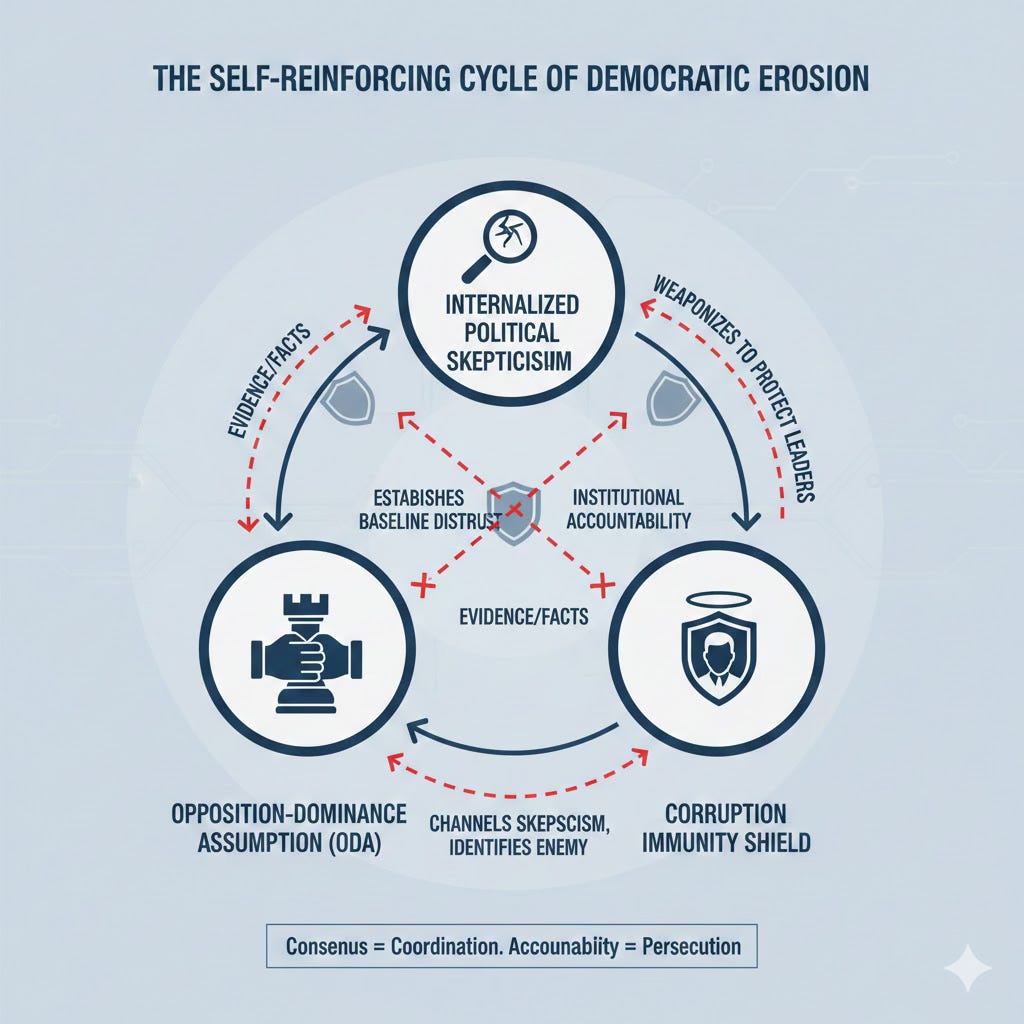
These three concepts don't just form a progression—they create a self-reinforcing system:
Internalized political skepticism establishes baseline distrust, making citizens receptive to claims that institutions are fundamentally broken.
Opposition-dominance assumption channels that skepticism into a specific theory of partisan control, identifying who supposedly owns the broken system.
Corruption immunity shield then weaponizes both dynamics to protect favored leaders, reframing accountability as persecution.
Each concept strengthens the others: when leaders denounce investigations, it deepens internalized skepticism; when institutional consensus emerges, it confirms opposition dominance; when evidence of misconduct surfaces, the shield converts it into proof of coordinated attack. The result is a closed loop where ordinary democratic correction becomes impossible—not because information is absent, but because the entire accountability infrastructure is presumed illegitimate from the start.
Institutional Consensus as Evidence of Coordination
Under standard democratic theory, convergence across multiple institutions is supposed to reassure the public. When courts, independent agencies, election administrators and mainstream media (aka the fourth estate) all affirm that an election was fair, that consensus is meant to stabilize legitimacy.
Under ODA, convergence can have the opposite effect. If people already assume structural capture, cross‑institutional agreement simply shows that “they” are all in on it. The more authoritative bodies that echo the same message, the more coordinated the perceived “coverup” appears. This dynamic helps explain why fact‑checking, independent audits and multi-pronged legal scrutiny so often fail to persuade hardened skeptics of election or corruption claims.
The problem is not the absence of information—it’s the prior belief about who controls the information system.
The United States After the 2020 Election
Following the 2020 U.S. presidential election, dozens of lawsuits alleging widespread fraud were filed and overwhelmingly rejected by state and federal courts—including by judges appointed by both parties and President Trump himself. Republican state officials in key battlegrounds certified results, and federal agencies described the election as secure. Yet Trump’s belief in a “stolen” election became entrenched in the Republican Party’s base.
This persistence is hard to explain by misinformation alone. But it’s easier to comprehend when presented with evidence that Trump’s constant reinforcement of ODA led many of his supporters to believe that:
Federal agencies, mainstream media and big tech platforms were already captured by liberal elites.
Courts and election officials—even Republicans—were compromised, cowardly, incompetent, or “in on it.”
In that context, institutional consensus from authoritative agencies against fraud claims functioned as evidence of coordination, not reliability or independence. Audits of undesirable electoral outcomes showing consistent results becomes further evidence of the complexity of the political oppositions collusion, not as the product of tireless independent professional and academic consensus.
President Trump’s “deep state” rhetoric further reinforced this mindset by casting the national security and federal bureaucratic apparatus as a permanent, unelected adversary embedded within the state. Research repeatedly shows that such conspiracy narratives are associated with lower institutional trust and can, in some contexts, correlate with support for political violence.
Populist Democracies Under Strain
Similar patterns appear in other democracies where populist or authoritarian‑leaning leaders face scrutiny:
In Brazil, Jair Bolsonaro and his allies framed the electoral tribunal and the Supreme Federal Court as politically motivated enemies, especially after he was banned from office and later convicted over J6-style coup‑related charges.
In Hungary and Turkey, critics and international organizations have documented executive moves to weaken judicial independence and media pluralism, while leaders depict domestic courts and foreign institutions like the EU as parts of a unified “globalist” or “foreign” front against the nation.
In all these cases, supporters are encouraged to view adverse rulings and critical coverage not as the work of independent institutions, but as attacks by a hostile establishment aligned with domestic or foreign enemies.
Left and Right Variants
ODA is not inherently right‑wing. Left‑wing movements can also develop structural capture narratives, for example by asserting that courts, central banks, mainstream media and international institutions are irrevocably captured by capital or imperial interests. One clear example of ODA’s presence in American political-left can be found in their views of the federal judicial system. Many liberal Americans view the Supreme Court's 6-3 conservative supermajority as structurally biased toward whites and economic elites. Frequently rendering perceptions of the courts decisions inherently suspect before they're even announced.
Other Historical Echoes of Opposition-Dominance Assumption
ODA‑like assumptions are not new. Earlier eras of democratic crisis show similar patterns of institutional recoding.
Weimar Germany: Radical actors on both right and left denounced parliamentary parties, courts and the civil service as tools of a corrupt “system” that had betrayed the nation, while the “stab‑in‑the‑back” myth framed defeat in World War I as the result of treachery by internal enemies embedded in state and political institutions.
McCarthy‑era United States: Anti‑communist campaigns depicted the State Department, universities, Hollywood and even the veterans as riddled with subversives, suggesting systematic enemy penetration of key institutions.
Cold War and anti‑imperialist contexts: In various Latin American and post‑colonial settings, courts, central banks and media outlets were portrayed by some actors as mere extensions of foreign powers or domestic oligarchies, rendering domestic institutional decisions suspect as products of external control.
In each case, institutional consensus could be framed as collusion among captured bodies, not as a sign that neutral procedures were working.

Why Opposition-Dominance Assumption Matters for Democratic Backsliding
ODA fills a conceptual and empirical gap between broad institutional distrust and formal democratic erosion. Researchers often distinguish between:
Specific support: satisfaction with particular decisions or performances.
Diffusive support: general attachment to institutions and regime principles.
ODA adds a third layer: structural capture belief. Here, citizens are not only unhappy with outcomes or skeptical of performance; they are convinced that “the other side” has taken over the referees—to interpret the rules and manage their application.
That belief has several implications:
Collapsed losers’ consent: if the enemy runs the institutions, losing cannot be legitimate by definition.
Resistance to correction: reports, audits, and rulings become further evidence of the complexity of the corruption and the reach of its colluders—not as persuasive evidence.
Incentives for elite norm-breaking: politicians who attack institutions are rewarded for “fighting back,” while those who defend institutional autonomy risk being branded traitors.
Democratic backsliding research shows that modern autocrats often erode checks and balances gradually through legal means. ODA explains why large segments of the public may tolerate or even cheer those moves: if institutions are already captured, hollowing them out or packing them can be framed as a necessary liberation.
Link to Conspiracism and Political Violence
Recent work finds that conspiracy beliefs are consistently and positively correlated with support for political violence, and in some cases with self‑reported violent behavior. Conspiracy narratives that scapegoat out-groups, frame threats as imminent and are endorsed by trusted elites are especially likely to be associated with violent attitudes.
ODA helps clarify this pathway. When citizens believe that official institutions are run by malevolent forces, and that those forces cannot be dislodged through normal politics, the perceived payoffs of institutional channels fall while the perceived legitimacy of disruptive action rises. The ground is prepared for arguments that “the system” must be confronted a-democratically, including through intimidation, insurrection or targeted attacks on officials.
How to Study and Measure Opposition-Dominance Assumption
Because ODA is a specific kind of belief about institutional structure, it is amenable to empirical study. Researchers can adapt items from work on institutional trust, hostile media perceptions and conspiracism, then tailor them to capture structural partisan control. Examples might include:
“Most major institutions in this country are controlled by people who hate what I stand for.”
“When courts, the media and government agencies agree on something, it usually means they are coordinating against people like me.”
“Even leaders from my own party who defend the system are probably part of the problem.”
These items can be combined into an ODA index and tested against outcomes such as:
Willingness to accept election losses.
Support for expanding executive power at the expense of courts, legislatures, and the media.
Endorsement of political violence or harassment of officials.
Experimental Designs
Experiments can probe how people with high versus low ODA respond to institutional consensus. For example:
Present respondents with scenarios in which multiple institutions endorse the same finding (e.g., “three independent courts and a bipartisan commission all find no significant fraud”).
Measure whether high‑ODA respondents are more likely to interpret consensus as proof of bias or coordination, rather than as increased credibility.
Such work would connect ODA directly to observed reactions under controlled conditions.
Cross‑National Comparisons
Cross‑national surveys and case studies can test whether ODA:
Is higher in countries or subgroups exposed to strong populist anti‑institutional rhetoric.
Predicts openness to backsliding, such as support for court‑curbing, media restrictions or emergency rule.
Interacts with media systems and social media use, in line with research showing that conspiracy beliefs and social media dynamics jointly shape institutional trust.
Implications for Democratic Practice
Recognizing ODA has practical consequences for those trying to shore up democratic resilience. Transparency and accountability remain essential. But when large segments of the public assume institutions are captured, more reports and more evidence do not automatically restore trust. Indeed, they can reinforce suspicion if every evidentiary report is assumed to come from a perceived out-group body.
This does not mean abandoning evidence. It means pairing evidence with efforts to change who is seen as speaking and on whose behalf. That includes:
Cross‑partisan elite signaling: leaders across the spectrum publicly defending institutional autonomy even when it hurts their own side.
Intra‑party discipline: parties sanctioning members who delegitimize neutral institutions for short‑term gain, instead of rewarding them with attention and promotions.
Institutional Design and Communication
Media and institutional design choices can also blunt ODA:
Reducing administrative fragmentation and clarifying chains of responsibility in election administration can limit the fog that conspiracy narratives exploit.
Investing in institutional communication that explains procedures in plain language, and that visibly includes diverse voices, can weaken the sense that institutions belong to one camp only.
Norms of Political Argument
Finally, political and civic actors need a vocabulary to distinguish between:
Legitimate structural critiques of bias, inequality and elite power, which are necessary in any democracy.
Blanket claims of capture that deny the very possibility of neutral arbitration and treat any adverse outcome as illegitimate by definition.
Naming opposition-dominance assumption is one way to draw that line. It allows journalists, scholars and citizens to say, in effect: “This is not just ordinary criticism of institutions. This is a claim that the entire field has been seized by the enemy, and it carries specific risks for how democracy can correct itself.”
Conclusion
Opposition-dominance assumption crystallizes a pattern visible across recent democratic crises: when citizens become convinced that referees aren’t simply fallible but owned by the other team, every whistle sounds like sabotage.
But ODA doesn’t operate in isolation. It functions as the central mechanism in a self-reinforcing system of democratic breakdown. Internalized political skepticism creates the baseline distrust that makes citizens receptive to claims about institutional capture. Opposition-dominance assumption gives that distrust a target, identifying which partisan enemy supposedly controls the system. Corruption immunity shield then weaponizes both dynamics to protect favored leaders, converting accountability into persecution. Each element strengthens the others in a closed loop that renders democratic correction nearly impossible.
By connecting research on affective polarization, hostile media perceptions, populist style, conspiracy belief and democratic backsliding, this framework offers a way to understand not just individual failures of trust, but how those failures combine into systematic democratic erosion.
It helps explain why institutional consensus so often fails to persuade: because convergence is read as coordination. Why accountability mechanisms get reframed as partisan warfare: because the institutions delivering accountability are presumed illegitimate. And why democracies can lose their self-correcting capacity long before formal collapse: because the entire feedback loop between evidence, institutions and public trust has been functionally severed.
Recognizing these patterns is the first step toward rebuilding democratic resilience. But recognition alone won’t fix the system. That requires confronting the reality that, once citizens internalize the belief that institutions belong to the enemy, more transparency and more evidence won’t automatically restore trust. Rebuilding that immune system won't happen overnight or by happenstance—it will require deliberate strategy, careful institutional design, and the discipline to start from first principles.
References
Allred, Micah. 2025. “Internalized Political Skepticism: When Distrust Become Democratic Identity.” Substack. https://substack.com/@micahblakeallred/note/p-184062488?r=623izf&utm_source=notes-share-action&utm_medium=web
Allred, Micah. 2026. “Corruption-Immunity Shield: When Accountability is Recast as Persecution.” Substack. https://substack.com/@micahblakeallred/note/p-184687178?r=623izf&utm_source=notes-share-action&utm_medium=web
Bermeo, Nancy. “On Democratic Backsliding.” Journal of Democracy 27, no. 1 (2016): 5–19. https://www.proquest.com/docview/1771758539?sourcetype=Scholarly%20Journals
Boer, Diana, Silvia Mari, Homero Gil de Zúñiga, Ahmet Suerdem, Katja Hanke, Gary Brown, Roosevelt Vilar, Michal Bilewicz“Conspiracy Theories and Institutional Trust: Examining the Role of Social Media.” Political Psychology 43, no. 2 (2022): 277–296. https://pure.psu.edu/en/publications/conspiracy-theories-and-institutional-trust-examining-the-role-of/
Electoral Integrity Project. 2020. “Electoral Backsliding.” Electoral Integrity Project. https://www.electoralintegrityproject.com/electoral-backsliding
Enders, Adam M., et al. 2024. “The Relationship Between Conspiracy Theory Beliefs and Political Violence.” Harvard Kennedy School Misinformation Review. https://misinforeview.hks.harvard.edu/wp-content/uploads/2024/11/enders_conspiracy_theory_beliefs_political_violence_20241212.pdf
Gendler, Naomi. 2024. “State Secrecy Explains the Origins of the ‘Deep State’ Conspiracy Theory.” Scientific American. https://www.scientificamerican.com/article/state-secrecy-explains-the-origins-of-the-deep-state-conspiracy-theory/
Gunther, Albert C., and Kathleen Schmitt. 2006. “Mapping Boundaries of the Hostile Media Effect.” Journal of Communication. https://onlinelibrary.wiley.com/doi/abs/10.1111/j.1460-2466.2004.tb02613.x
Iyengar, Shanto, Yphtach Lelkes, Matthew Levendusky, Neil Malhotra, and Sean J. Westwood. “The Origins and Consequences of Affective Polarization in the United States.” Annual Review of Political Science. https://papers.ssrn.com/sol3/papers.cfm?abstract_id=3394075
Kahan, Dan M. 2017. “Misinformation and Identity-Protective Cognition.” Yale Law School Public Law. https://www.semanticscholar.org/paper/Misconceptions,-Misinformation,-and-the-Logic-of-Kahan/4485b22f4d13b167e35ea4cf5a272d6d88396feb
Levendusky, Matthew S. 2019. “Review of Uncivil Agreement: How Politics Became Our Identity, by Lilliana Mason.” Public Opinion Quarterly 83, no. 2 (2019): 475–477. https://academic.oup.com/poq/article-abstract/83/2/475/5513886?login=false
Mason, Lilliana. 2018. “Uncivil Agreement: How Politics Became Our Identity.” Chicago: University of Chicago Press. https://academic.oup.com/poq/article-abstract/83/2/475/5513886?login=false
Moffitt, Benjamin. 2016. “The Global Rise of Populism: Performance, Political Style, and Representation.” Stanford, CA: Stanford University Press. https://psi424.cankaya.edu.tr/uploads/files/Moffitt,%20The%20Global%20Rise%20of%20Populism%20_%20Performance,%20Political%20Style%20(Stanford%20University%20Press).pdf
Tokaji, Daniel P. 2024. “Democratic Backsliding: Causes, Consequences, and Solutions?” New York: Academy of Political Science. https://academic.oup.com/psq/pages/democratic-backsliding-causes-consequences-and-solutions?login=false
Vegetti, Federico, and Levente Littvay. 2021. “Belief in Conspiracy Theories and Attitudes Toward Political Violence.” Italian Political Science Review 52, no. 1 (2022): 18–32. https://www.cambridge.org/core/journals/italian-political-science-review-rivista-italiana-di-scienza-politica/article/belief-in-conspiracy-theories-and-attitudes-toward-political-violence/89835D7B5CD9036BC8717E484D5F4C0B
Here is part 1 for readers:
https://substack.com/@micahblakeallred/note/p-184062488?r=623izf&utm_medium=ios&utm_source=notes-share-action
Here is part 2 for readers:
https://substack.com/@micahblakeallred/note/p-184687178?r=623izf&utm_medium=ios&utm_source=notes-share-action