
Partisan Moral Drift
Why political loyalty overrides moral consistency: A study of how identity reshapes our sense of right and wrong. Part of the "Naming the Democratic Breakdown" series.

Naming the Democratic Breakdown: Partisan Moral Drift (PMD)
By Micah Blake Allred
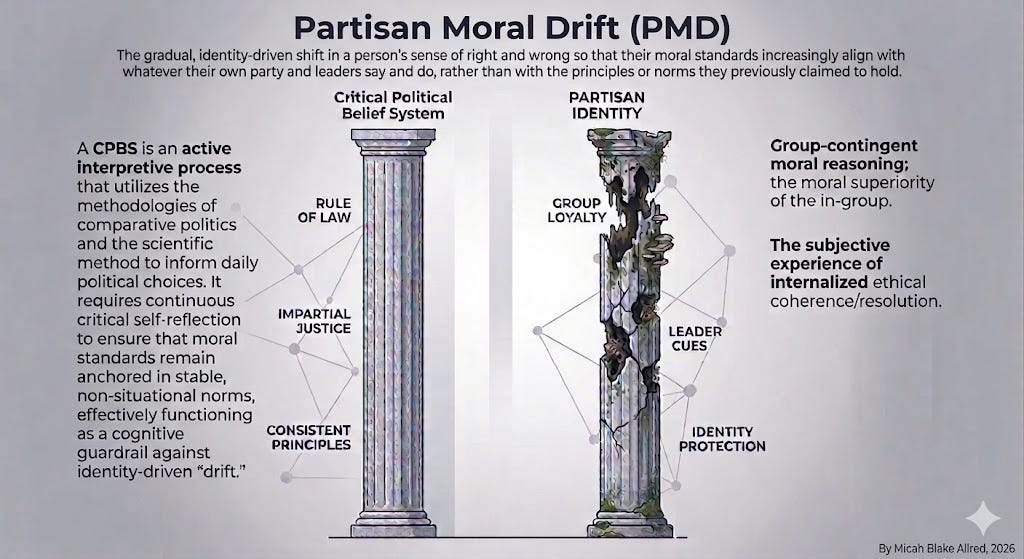
Over the last decade, a lot of us have watched friends and family move from ‘the justice system should be neutral’ to ‘it’s good when our side uses it to hit back.’ That’s not just hypocrisy. It’s a slow shift in what feels moral in politics. I’ve termed this gradual political shift: Partisan Moral Drift (PMD).
Partisan Moral Drift is a long‑term, identity‑driven process in which individuals’ moral standards gradually shift to remain consistent with their partisan camp’s evolving positions and leaders, rather than with prior principles or institutional norms. It is not a momentary double standard or a single act of hypocrisy; it is a cumulative realignment of what feels morally right, wrong, or obligatory in politics.
Three features distinguish PMD:
Partisan‑anchored moral change. Moral evaluations move in the direction of co‑partisan elites and leaders, especially when those cues clash with neutral institutions such as courts, election authorities, or the Justice Department.
Identity‑protective updating. People rarely experience themselves as “changing morals.” Instead, motivated reasoning and identity‑protective cognition help them reinterpret new party positions as consistent with their enduring sense of being good, loyal members of “their side.”
Environmental plasticity of moral priorities. Work on moral foundations and political ideology increasingly shows that citizens’ moral priorities are shaped by their environment and can shift within a few years. PMD is one mechanism: sustained partisan and leader cues slowly reweight which moral concerns (e.g., impartiality vs loyalty, fairness vs retribution) feel central and how they apply to institutions.
Conceptually, PMD sits downstream of social‑identity and motivated‑reasoning theories, but upstream of the more specific democratic‑breakdown dynamics I’ve named elsewhere: Internalized Political Skepticism, Opposition‑Dominance Assumption, and Corruption‑Immunity Shields. It describes how the moral “floor” on which those processes rest can move.
How Partisan Moral Drift Works: A Micro‑Mechanism
A simplified mechanism for PMD proceeds in five steps:
Elite moral framing. Party leaders and aligned media frame a situation or institution in moral terms (e.g., calling an opponent “crooked,” denouncing a “rigged” justice system, or casting prosecutions as righteous revenge).
Dissonance with prior beliefs. Supporters feel tension between earlier norms (e.g., “presidents shouldn’t pressure prosecutors”) and the new cues, but they also feel strong pressure to maintain loyalty to the party and leader.
Identity‑protective reinterpretation. To resolve dissonance, they adopt narratives that make the leader’s position feel consistent with their moral self‑image (“this case is unique,” “the system is already corrupt,” “they did it first”).
Generalization into a new rule. Repeated episodes turn those situational justifications into new general moral rules (e.g., from “justice must be impartial” to “justice is righteous when it punishes our enemies and corrupt when it targets us”).
Stabilization. Once these new rules align with partisan identity and social networks, they feel like the principles the person always held; reverting to the earlier standard risks betraying both self and group.
Partisan Moral Drift is this long‑run accumulation of identity‑protective updates into a durable, leader‑centric moral framework that subverts rational/critical political belief systems.
Case Study: Impartial Justice in Trump’s DOJ
The evolution of Republican attitudes toward prosecution, impartial justice, and the Department of Justice (DOJ) under Donald Trump illustrates PMD with unusual clarity. The trajectory runs from moralized calls to jail Hillary Clinton, through acceptance of Trump’s decision not to prosecute her, to widespread tolerance for his second‑term efforts to use the DOJ and related tools against hundreds of his political adversaries.
Moralizing the Prosecution of Hillary Clinton
In 2015–2016, the investigation into Hillary Clinton’s use of a private email server was framed as a moral and legal scandal. A CBS/AP–GfK poll in August 2015 found that 56 percent of Americans believed Clinton “broke the law” by using a private email account and server, including 39 percent who said she did so intentionally and 17 percent unintentionally. Only 6 percent said she did nothing wrong; 36 percent called it bad judgment but not illegal.
Republicans were especially likely to see her as a lawbreaker: 71 percent of Republicans said Clinton intentionally broke the law, and another 18 percent said she unintentionally broke the law. In the same poll, 85 percent of Republicans viewed the email issue as a “major problem,” compared with 22 percent of Democrats. For many Republican voters, Clinton’s alleged criminality was not just a policy concern; it was a moral indictment.
Trump amplified and personalized that moral framing. At rallies, crowds chanted “lock her up,” and he repeatedly endorsed and escalated the message. Fact‑checking by PolitiFact and Poynter documents at least seven occasions in 2016 where Trump explicitly said Clinton should go to jail, including statements like “Hillary Clinton has to go to jail … she is guilty as hell” and “for what she’s done, they should lock her up; she’s disgraceful,” as well as his famous debate remark, “because you’d be in jail.” He later falsely claimed he had not said “lock her up,” blaming it on the crowd; fact‑checkers rated that denial as flagrantly false.
At this stage, the implicit moral rule for many Republicans was straightforward: if someone breaks the law at this level, justice demands prosecution and even imprisonment. Failing to prosecute was framed as evidence of a rigged system and entrenchment of impunity for America’s political elite.
After winning the 2016 election, Trump quickly reversed course. In late November 2016, he signaled in public comments that he no longer wanted to pursue criminal investigations into Clinton or the Clinton Foundation, telling reporters that he did not want to “hurt the Clintons” and that they had “been through a lot.” He did not appoint the “special prosecutor” he had promised on the debate stage.
Despite the intense moralism of the campaign, there was no sustained mass revolt inside his coalition over this reversal. The same base that had demanded Clinton’s imprisonment now largely accepted Trump’s choice to “move on,” often recasting it as magnanimous or strategically wise. The moral imperative shifted from “a just leader must jail his corrupt opponent” to “a strong leader can show mercy and focus on other priorities.”
From a PMD perspective, this is the first visible adjustment:
The belief that Clinton was a lawbreaker remained widespread among Republicans, but the moral necessity of prosecution softened because the in‑group leader chose restraint.
Many supporters resolved the dissonance by reinterpreting non‑prosecution not as a moral failure, but as a sign of Trump’s strength, mercy, or strategic acumen, rather than revisiting their earlier moral absolutism.
The underlying standard—when is it morally required to prosecute a political rival?—blurred slightly but already moved in a more leader‑centric direction.
Redefining “Law and Order”
Over Trump’s first term, the DOJ and the FBI became central villains in his rhetoric. He denounced the Russia probe as a “witch hunt,” accused career officials of being part of a “deep state,” and publicly criticized prosecutors and judges in cases involving his allies. Trump’s first Attorney General, Jeff Sessions, was pushed out after recusing himself from the Russia investigation; subsequent appointees faced open demands for loyalty.
Public opinion on justice institutions moved in a sharply partisan direction. A 2025 Pew Research Center survey found that only 39 percent of Americans viewed the DOJ favorably, while 46 percent viewed it unfavorably, but party breakdowns were striking. Among Republicans and Republican leaners, 51 percent now viewed DOJ favorably, an increase of 18 points from the previous year; among Democrats and Democratic leaners, only 28 percent viewed DOJ favorably, a decrease of 27 points. The FBI showed a similar pattern: favorable views among Republicans rose, while Democrats’ confidence declined.
Analysts note that earlier in the 2000s and 2010s, partisan gaps in attitudes toward the DOJ and the FBI were smaller and more stable; by the mid‑2020s, trust had become heavily conditioned on which party held the presidency and how those agencies were perceived to treat Trump. A libertarian assessment summarized the result by saying that approval of the DOJ and the FBI “depends on who is in power,” reflecting the sense that these agencies have become “partisan weapons” in the eyes of each camp.
At the same time, when Trump was personally indicted on federal and state charges related to efforts to overturn the 2020 election and other alleged crimes, Republican moral evaluations diverged sharply from the publics. A 2023 Quinnipiac national poll found that 54 percent of Americans said Trump should be prosecuted on federal charges linked to his attempts to overturn the 2020 election, while 42 percent said he should not. The partisan split was dramatic: 95 percent of Democrats favored prosecution, 57 percent of independents favored prosecution, but only 12 percent of Republicans favored prosecuting him, with 85 percent of Republicans opposed.
On the seriousness of the charges, 64 percent of Americans said they were very or somewhat serious, but nearly half of Republicans said the charges were “not serious at all.” The poll also found that 28 percent of Republicans said the indictment made them view Trump more favorably, a classic Corruption‑Immunity Shield pattern in which legal accountability is reinterpreted as persecution that enhances the leader’s standing.
Compounding this, panel and cross‑sectional polling shows that many Republicans still endorse the abstract proposition that someone convicted of a felony should not be eligible to be president, 58 percent agreed with that statement in the same Quinnipiac survey, yet they reject prosecution and downplay the seriousness of Trump’s own alleged crimes. This gap between abstract rule and concrete application is one of the clearest signatures of Partisan Moral Drift.
Second Term: Promising Political Prosecution
Trump’s second term, beginning in January 2025, brought more direct and sustained efforts to use the DOJ and related tools against perceived adversaries. Plans for such a “second‑term transformation” of the executive branch, often grouped under the “Project 2025” orbit, had been circulated by his allies even before the election, including proposals to reclassify tens of thousands of civil servants, purge non‑loyal officials, and centralize presidential control over DOJ, FBI, and other agencies.
Once back in office, Trump moved aggressively along those lines. A detailed ABC News report and a comprehensive tracker by Protect Democracy document at least 22 federal prosecutions, investigations, or other actions that appear to be retaliatory in nature as of early 2026.
Repeated efforts to prosecute former FBI director James Comey, whom Trump had publicly vowed to target. DOJ brought charges related to Comey’s handling of memos and classified information, but a federal judge dismissed the case because Trump had unlawfully appointed the special counsel leading the investigation.
Criminal charges against New York Attorney General Letitia James, who had won a civil fraud judgment against Trump in state court. DOJ indicted her on mortgage‑related charges; those charges were later thrown out by a judge, again citing problems with the appointment of key prosecutors.
Attempts to indict six Democratic members of Congress (all veterans or with national security backgrounds) for “seditious” behavior after they recorded a video reminding service members of their duty to refuse illegal orders. A grand jury refused to indict them—an exceptionally rare rebuke.
Investigations of Federal Reserve chair Jerome Powell and governor Lisa Cook, widely read as politically motivated given Trump’s public attacks on the Fed and its independence. The Protect Democracy tracker highlights these as examples of punishing officials for decisions made in the course of lawful duty.
Revocations of security clearances and protection details for dozens of political adversaries, including former President Joe Biden, former Secretary of State Hillary Clinton, Vice President Kamala Harris, former Republican Representative Liz Cheney, Representative Adam Schiff, and numerous former intelligence and national security officials who had been publicly critical of Trump.
Legal outcomes repeatedly suggest weak or politicized cases: cases dismissed by judges, indictments rejected by grand juries, or investigations abandoned without charges. Civil‑society groups argue that the pattern “frequently veers far over the line into political retaliation,” while acknowledging that not every investigation is necessarily illegitimate.
Critically, the public sees much of this. A Reuters/Ipsos poll in October 2025 reported that 55 percent of Americans agreed that Trump was using federal law enforcement to target his enemies, while only 26 percent disagreed. That included about three in ten Republicans who said he was doing so. At the same time, a separate States United Democracy Center/YouGov survey found that 61 percent of Americans disagreed that Trump should be able to direct the DOJ to pursue charges against his political opponents, with only 20 percent agreeing; among Republicans, support for giving him that power still did not reach an outright majority.
A Marquette Law School national survey adds a final layer. In November 2025, 58 percent of Americans said the criminal cases brought against Trump in 2023–2024 were justified, and 42 percent said they were unjustified; but 77 percent of Republicans said those cases against Trump were unjustified. When asked about criminal cases against Trump’s political opponents, 55 percent of Americans said DOJ had filed unjustified cases, and 45 percent said justified, with Democrats much more likely than Republicans to see those cases as unjustified.
Taken together:
A majority of Americans see Trump as using law enforcement against his enemies, and most still reject the idea that a president should do that.
Republicans strongly reject prosecutions of Trump, often view them as illegitimate or “not serious,” and yet are more split on prosecutions of his perceived opponents.
Meanwhile, Republicans’ favorability toward the DOJ and the FBI has rebounded under Trump’s second term, at the same time these agencies are being used in obviously partisan and retaliatory ways, while Democrats’ trust has collapsed.
This is precisely the kind of environment PMD describes: moral standards about what justice agencies should do have drifted from impartial enforcement toward leader‑ and in‑group‑centric enforcement, even as citizens maintain abstract attachment to rule‑of‑law norms.
Partisan Moral Drift’s Conceptual Use
Existing concepts already explain pieces of this story:
Motivated reasoning and identity‑protective cognition: people selectively interpret information to protect their group identity and avoid cognitive dissonance.
Partisan elite cue‑taking and belief‑system constraint: citizens often change issue positions when party leaders do, and shifts in central attitudes propagate through belief networks.
Moral foundations and moralization of politics: political attitudes are increasingly framed as matters of good and evil, and moral priorities can shift with context.
Partisan Moral Drift adds at least three things:
A moral focus over time. PMD draws attention to the trajectory of moral standards themselves. It is not just that people apply their existing morals selectively; the content of their moral rules about institutions and leaders changes under sustained partisan and leader influence.
A bridge from psychology to institutional breakdown. PMD connects individual‑level moral updating to system‑level outcomes: when enough citizens come to see loyal enforcement as morally superior to impartial enforcement, it becomes psychologically easier to accept or support politicization of the DOJ, the FBI, and the courts.
An explanation for sincere asymmetry. PMD explains why people can sincerely insist that jailing Clinton would have been righteous while calling prosecutions of Trump “witch hunts,” even when the abstract rule (“lawbreakers should be prosecuted”) remains in their self‑description. The moral baseline has drifted so that what counts as a “lawbreaker” or a “legitimate prosecution” is strongly conditioned by partisan identity.
Recent empirical work on “flexible morals” under misinformation supports the plausibility of PMD. Experiments by Kim and co‑authors show that voters often hold opposing politicians to strict factual standards, while allowing their favored politicians to share divisive misinformation if it expresses a “deeper truth” aligned with group grievances. PMD can be understood as the long‑run effect of repeatedly applying such flexible standards in one direction: over time, the moral line itself moves.
Relationship to Other Original Terms
Internalized Political Skepticism (IPS) describes when distrust of institutions becomes a stable part of political identity, especially distrust of independent information and oversight. PMD makes IPS more likely by recoding skepticism of previously respected political institutions and opposition leaders as a moral obligation when those entities contradict the leader.
Opposition‑Dominance Assumption (ODA) captures the belief that key institutions are structurally controlled by the enemy camp, so that any adverse decision is read as partisan aggression. Once PMD has shifted moral standards so that impartial enforcement feels like persecution, it is a short step to believing that prosecutors and judges must be “theirs.”
Corruption‑Immunity Shield (CIS) describes how evidence of a leader’s wrongdoing can be reinterpreted as proof of persecution, increasing support. PMD helps explain why this can feel morally satisfying: if the moral baseline has shifted to sanctify the leader’s cause and cast watchdogs as corrupt, then every indictment feels like confirmation that the leader is bravely opposing a corrupt system.
Partisan Moral Drift in Academic and Public Discourse
For scholars, naming Partisan Moral Drift clarifies that the problem is not only factual disagreement or polarization of trust; it is a slow, identity‑driven transformation of moral expectations about what state power should be used for, especially coercive power like criminal law. That suggests concrete research agendas: panel studies tracking moral rules, experiments manipulating leader vs opponent attributions for identical actions, and belief‑network analyses examining how moral judgments migrate toward partisan identity nodes.
For public discourse, PMD provides language to describe a pattern many people have observed in their families and communities: long‑time “law and order” conservatives coming to see attacks on the justice system and weaponized prosecutions as not just acceptable but morally necessary when their leader is involved. It helps distinguish between ordinary hypocrisy and a deeper process where the moral floor itself has shifted.
Conclusion
In the justice system, we can now see the full arc of Partisan Moral Drift: from chanting “lock her up” as a moral imperative, to accepting Trump’s decision not to prosecute Clinton, to treating later prosecutions of Trump as witch hunts and prosecutions of his enemies as, at best, ambiguous. The same voters who once insisted that serious lawbreakers must be punished apolitically now overwhelmingly oppose even bringing Trump to trial, while their trust in the US justice system rises or falls almost entirely with which party—and leader—is in charge.
Once you see that pattern, it becomes hard to pretend that we’re only arguing about facts or legal technicalities. We’re watching the underlying moral baseline move. Each new exception, each new rationalization, every “this case is different,” “they started it,” “the system is rigged anyway,” nudges people further away from impartial rules and deeper into a world where the justice system feels righteous only when it serves their side. That is the structure PMD illuminates.
Partisan Moral Drift is not confined to Trump or to Republicans. Any of us can slip into it whenever we hypocritically treat the same political acts (in ends or means) as unforgivable in our opponents and understandable, even noble, amongst ourselves. The point of naming PMD is not to declare ourselves immune, but to give ourselves and each other a clearer way to notice when our morals start quietly bending around the shape of our political identities. If enough citizens can see that drift in time and resist it, then independent courts, neutral law enforcement, and shared rules still have a chance. If we can’t, the US justice system will keep looking less like a public institution and more like a weapon, and it will feel increasingly natural to many people that this is how democracy is supposed to work.
References
CBS News / AP–GfK. “Poll: Email investigation damaged Hillary Clinton’s image.” August 2015. https://www.cbsnews.com/news/poll-email-investigation-damaged-hillary-clintons-image/
Poynter (PolitiFact). “Trump now denies saying, ‘Lock her up.’ But he said Hillary Clinton should go to jail at least 7 times.” June 4, 2024. https://www.poynter.org/fact-checking/2024/did-trump-say-lock-her-up/
Jocelyn Kiley and Andy Cerda. “How Americans Rate ICE, FBI, Justice Department and Other Federal Agencies.” Pew Research Center, August 27, 2025. https://www.pewresearch.org/politics/2025/08/27/republicans-views-of-justice-department-fbi-rebound-as-democrats-views-shift-more-negative/
Quinnipiac University Poll. “Majority Of Americans Say Trump Should Be Prosecuted On Federal Criminal Charges Linked To 2020 Election, Quinnipiac University National Poll Finds; DeSantis Slips, Trump Widens Lead In GOP Primary.” 2023. https://poll.qu.edu/poll-release?releaseid=3877
ABC News. “Here’s a list of the individuals, including James Comey, targeted by Trump administration.” April 27, 2026. https://abcnews.com/US/list-individuals-including-lisa-cook-targeted-trump-administration/story?id=124968309
Protect Democracy. “Tracking retaliatory use of arrests, prosecutions, and investigations against perceived political opponents.” Retaliatory Action Tracker, updated 2025–2026. https://protectdemocracy.org/work/retaliatory-action-tracker/
Reuters/Ipsos via The Straits Times. “Majority of Americans think Trump is using federal law enforcement to target enemies: Reuters/Ipsos poll finds.” October 22, 2025. https://www.straitstimes.com/world/united-states/majority-of-americans-think-trump-is-using-federal-law-enforcement
States United Democracy Center. “Survey: Americans Don’t Want the Justice Department Investigating Political Opponents.” October 16, 2025. https://statesunited.org/resources/justice-department-survey/
Marquette Law School Poll. “New Marquette Law School national survey finds 55% say DOJ has filed unjustified cases against Trump’s political opponents, 58% say cases against Trump are justified.” November 19, 2025. https://www.marquette.edu/news-center/2025/marquette-law-poll-finds-55-say-doj-has-filed-unjustified-cases-against-trumps-politi
Jonathan Haidt and Jesse Graham. “When Morality Opposes Justice: Conservatives Have Moral Intuitions That Liberals May Not Recognize.” Social Justice Research 20, no. 1 (2007): 98–116.
University of Nebraska–Lincoln. “Study shakes foundation of morals’ role in political ideology.” News release, 2025. https://news.unl.edu/newsrooms/today/article/study-shakes-foundation-of-morals-role-in-political-ideology/
Minjae Kim et al. “Flexible morals: A key reason American voters support divisive misinformation.” MIT Sloan / Rice Business press coverage, 2024. Press release: https://mitsloan.mit.edu/press/flexible-morals-a-key-reason-american-voters-support-divisive-misinformation and summary: https://mitsloan.mit.edu/ideas-made-to-matter/us-voters-exhibit-flexible-morals-when-confronting-misinformation
Reason Magazine. “With government agencies turned into partisan weapons, trust is a tribal matter.” August 31, 2025. https://reason.com/2025/09/01/after-years-of-abuses-approval-of-the-fbi-and-doj-depends-on-who-is-in-power/
Axios. “Inside Trump ’25: A radical plan for Trump’s second term.” July 22, 2022. https://www.axios.com/2022/07/22/trump-2025-radical-plan-second-term