
THE GHOST CABINET
Part of “Naming the Democratic Breakdown”: A series introducing original political science terms to help define modern democratic erosion.

By Micah Blake Allred
March 26, 2026
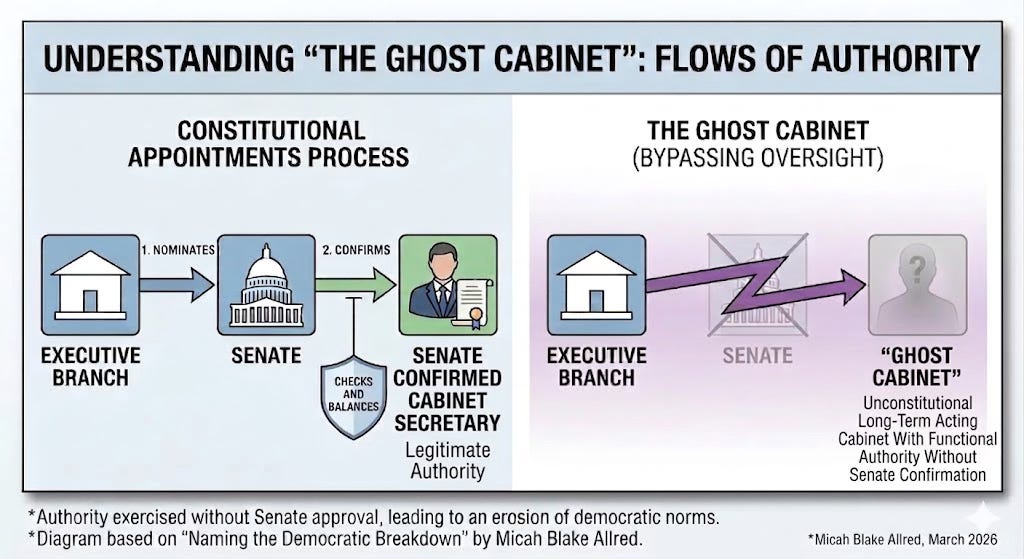
The United States Constitution does not explicitly anticipate a presidency that governs through temporary officials. It assumes that the most powerful positions in government will be filled through a shared process between the executive and legislative branches. The president nominates. The Senate confirms. Authority flows from that joint act.
What happens when that process is systematically bypassed—not in open defiance, but through legal gray areas, strategic vacancies, and political indifference?
A pattern emerges. I call it a ghost cabinet: a governing structure in which officials exercise the functional authority of Senate-confirmed positions without actually receiving Senate confirmation, often for extended periods of time. It is not a single violation. It is a method. And over the past decade, it has become increasingly normalized by President Donald Trump.
But the danger isn’t merely administrative. It’s constitutional.
The Constitutional Design—and Its Vulnerability
The Appointments Clause of Article II requires that principal officers of the United States be appointed “by and with the Advice and Consent of the Senate.” It was designed as a structural safeguard against executive overreach. In Federalist No. 76, Alexander Hamilton described Senate confirmation as a necessary check against “a spirit of favoritism” in presidential appointments. Without it, he warned, presidents would be inclined to elevate individuals based on loyalty rather than merit.
The modern administrative state requires some flexibility. Vacancies occur. Officials resign or are removed unexpectedly. To address this, Congress passed the Federal Vacancies Reform Act, which allows temporary “acting” officials to fill roles for limited periods—generally between 210 and 300 days.
The law was intended as a stopgap, but it has increasingly functioned as a workaround.
This is where the constitutional vulnerability emerges. The Appointments Clause depends not only on formal rules, but on political actors choosing to enforce them. When that enforcement weakens, the distinction between temporary necessity and strategic evasion begins to collapse.
At that point, what appears to be administrative flexibility becomes something more serious: a slow-moving constitutional crisis.
The First Modern Ghost Cabinet
The modern ghost cabinet was employed by the first Trump administration from 2017-2021. No department illustrated the phenomenon clearer than the Department of Homeland Security (DHS). Following the ‘resignation’ of Secretary Kirstjen Nielsen in April 2019, the DHS entered an extended period of unstable and legally contested leadership. Acting officials cycled through the role, often under disputed authority.
In August 2020, the Government Accountability Office concluded that key figures, including Chad Wolf and Ken Cuccinelli, were serving unlawfully due to improper succession procedures. Federal courts later invalidated multiple policies they had issued—not based on the substance of those policies, but because the officials lacked legal authority to enact them.
The consequences were tangible. Immigration rules were voided. Administrative actions collapsed under legal scrutiny. Governance itself became less effective because the officials governing America’s national security did not have the constitutional authority to do so.
This was not an isolated issue. In President Trump’s first term, DHS was led by acting administrators for a majority of his time in office. But that flexibility came at a constitutional cost. Acting officials, by definition, lack the institutional legitimacy and independence that Senate confirmation provides, and it is a way President Trump has broken his end of the social contract with Americans, because acting cabinet secretaries definitionally serve at the pleasure of the president without the stabilizing force of congressional approval.
The Evolution of the Model
In President Trump’s second term, the structure of the ghost cabinet evolved rather than disappeared. Instead of relying solely on vacancies, the administration increasingly used what observers described as “multi-hatting”: assigning already-confirmed officials to serve simultaneously in multiple roles for which they had not been confirmed.
For instance, Marco Rubio was confirmed as Secretary of State on Inauguration Day, but he was subsequently named National Security Advisor, head of the U.S. Agency for International Development, and acting archivist at the National Archives and Records Administration. Cabinet members are being tasked with overseeing agencies far outside the scope of their original appointments.
Furthermore, the practice of utilizing temporary acting officials in top cabinet positions has recently resurfaced at the Department of Homeland Security. On March 5, 2026, President Trump fired DHS Secretary Kristi Noem. Following her ouster, Senator Markwayne Mullin was installed to serve as the acting DHS Secretary while his formal confirmation was pending, a role he filled until he was officially confirmed by the Senate on March 23, 2026.
The constitutional issue remains the same, however. Senate confirmation applies to specific offices, not to individuals in general. When an official confirmed for one role exercises the authority of another, the confirmation process is effectively bypassed. The mechanism is more complex than a vacancy. The outcome is indistinguishable.
A ghost cabinet does not require empty chairs. It requires only that authority be exercised without proper authorization. They are executive apparitions—wearing the skin of public servants, without ever earning the mandate.
Politically Sustaining the Ghost Cabinet
The persistence of a ghost cabinet cannot be explained by institutional design alone. It requires a political environment that tolerates, or even rewards, the erosion of procedural norms. This is where broader dynamics become relevant.
The concept of internalized political skepticism helps explain why such institutional degradation does not produce widespread backlash. When distrust in government becomes embedded in political identity, procedural violations are not necessarily perceived as problems. They are often interpreted as justified responses to a corrupt system.
Closely related is the corruption-immunity shield, a dynamic in which evidence of misconduct is reframed as persecution by hostile institutions. Under this logic, attempts to enforce constitutional norms are seen not as safeguards, but as partisan attacks.
Together, these forces create a permissive environment for executive overreach. The erosion of checks and balances does not trigger accountability because the legitimacy of those checks is itself contested. A ghost cabinet is not merely a legal phenomenon—it is a political one.
The Post-Election Pattern
Following the 2018 midterm elections, several high-level officials departed from the Trump administration within a short period, including Attorney General Jeff Sessions and Interior Secretary Ryan Zinke. After the 2020 election, the pattern intensified. Defense Secretary Mark Esper was dismissed days after the election. Attorney General William Barr announced his resignation weeks later. Additional cabinet officials left in rapid succession around January 6th, 2021. According to NPR, at least a dozen officials were fired or forced out during the post-election purge in late 2020 and replaced by loyalists. In each case, Trump appointed acting officials to implement his political goals during periods of heightened instability.
These moments are not incidental. They reveal how electoral shocks can trigger executive reshuffling—especially under President Trump—creating conditions in which acting leadership becomes more prevalent.
My 2026 Midterm Ghost Cabinet Predictions
My most significant concern is not the political abuses of the past, but those that this pattern tells me are yet to come in Trump 2.0. If Republicans lose the Senate in the 2026 midterms and the president faces an oppositional Senate controlled by the Democrats in 2027, his incentive to quickly clean house of cabinet officials he suspects may disappoint him over the next two years will be too tempting to ignore. Like before, Trump will presumably fire several cabinet officials just like he did after poor election performances in 2018 and 2020. He will do this in the hopes that a lame-duck Republican Senate will hastily approve his nominees before Democrats make his nomination process much more difficult, and that voters will likely forget the implications of the political failures of restaffing his cabinet in 2026 when they return to the polls again two years later in 2028.
If this scenario comes to pass, a ghost cabinet of acting cabinet secretaries governing over the US at President Trump’s discretion will be a certainty. For how long? That, I’m not comfortable speculating on. Because if vulnerable and retiring Republican lame-duck senators are the ones Trump must rely on to pass his relatively unqualified cabinet nominees—likely after a poor midterm performance agitated by the president’s policies—they may not be in a friendly mood to approve nominations. If such a lame-duck Republican Senate were to come to pass and further fail to approve all of Trump’s cabinet appointees before the victorious Democrats retook the chamber, then the scenario of an unconstitutionally sustained ghost cabinet becomes a serious possibility.
A Slow-Moving Constitutional Crisis
A constitutional crisis does not always arrive in dramatic form. It can emerge gradually, through the accumulation of small deviations from established norms.
I believe ghost cabinets rise to the level of such a crisis.
No single acting appointment may break the system. No single vacancy may undermine the Constitution. But when temporary leadership becomes routine, when the American people’s democratic consent becomes optional in practice, and when oversight depends on political will that is no longer present, the decline of our democratic norms will surely lead to the decline of our democracy.
The Appointments Clause remains in the Constitution. Faded from standing the tests of time since its transcribing nearly two-and-a-half centuries ago, yet it remains there in the heart of our nation to this day. And its ultimate message remains as true today as it has been since our nation’s founding.
Strive for a more perfect union.
Here’s an updated and summarized version I later published with Our National Conversation, because the news moves fast!
https://www.ournationalconversation.org/the-ghost-cabinet/